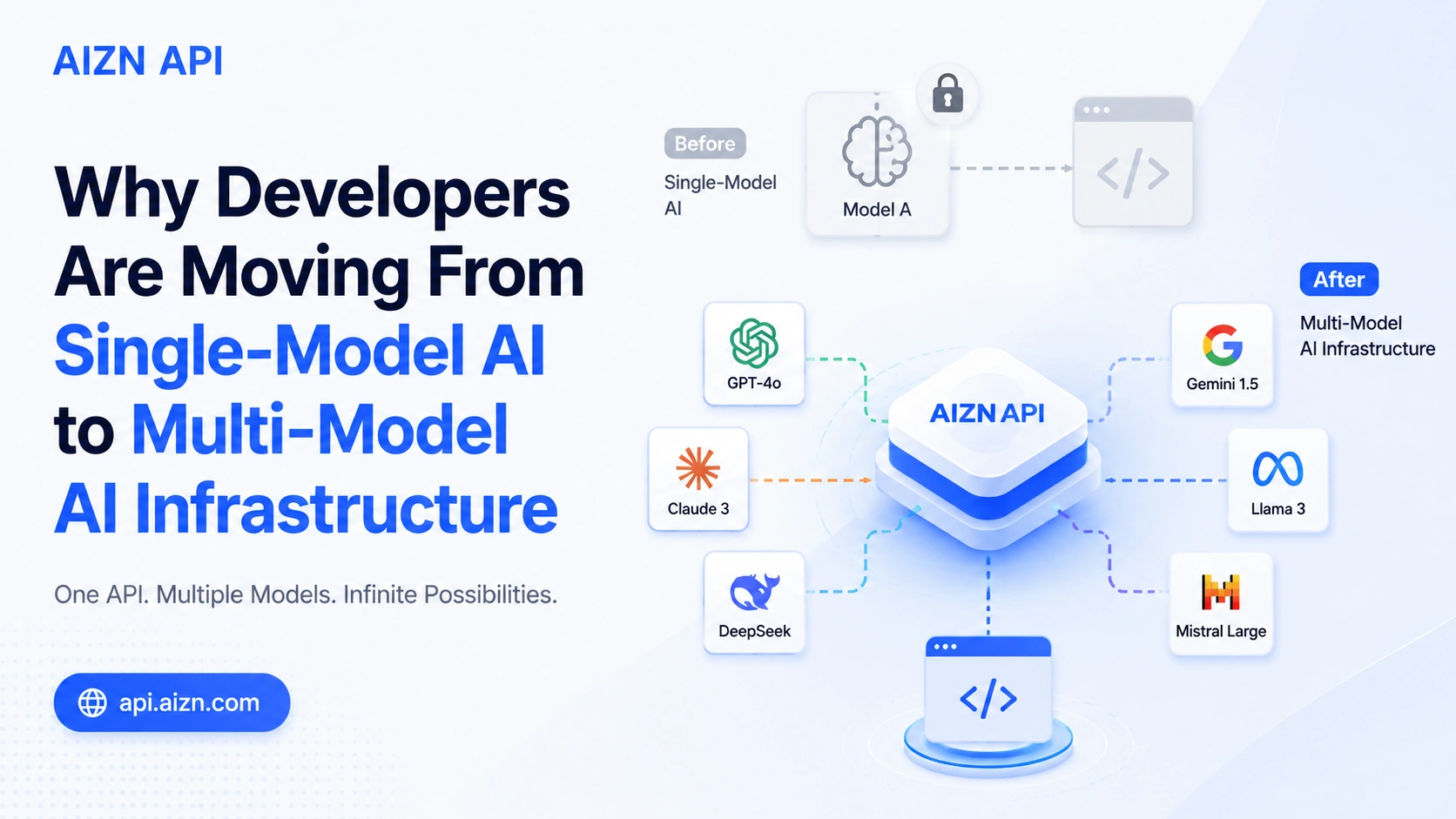
Early AI applications were usually built around a single model provider.
A team would choose:
- OpenAI
- Claude
- Gemini
- DeepSeek
- another LLM provider
and connect directly to that API.
At first, this approach felt simple.
But as AI products became more complex, developers started running into infrastructure limitations.
Different models perform differently across:
- reasoning tasks
- coding workflows
- long-context processing
- multilingual generation
- inference cost
- response speed
Eventually, many teams realized something important:
No single model is best for every workload.
That is why modern AI infrastructure is increasingly becoming multi-model.
The Single-Model Problem
Building around one provider creates hidden risks.
Over time, teams often encounter problems such as:
- rising API costs
- rate limits
- latency instability
- provider outages
- model capability gaps
- lack of routing flexibility
As products scale, these problems become operational issues instead of technical details.
The challenge is no longer:
“Which model is best?”
The challenge becomes:
“How do we build infrastructure flexible enough to use multiple models?”
Different AI Models Have Different Strengths
Modern AI workflows are highly diverse.
For example:
| Task Type | Better Model Characteristics |
|---|---|
| Fast automation | Lower latency |
| Long documents | Large context window |
| Coding workflows | Strong reasoning |
| High-volume processing | Lower cost |
| Multilingual tasks | Better language support |
One provider rarely performs best across every category.
This is why multi-model architecture is becoming more common.
What Is Multi-Model AI Infrastructure?
Multi-model AI infrastructure allows applications to use multiple AI providers inside one system.
Instead of depending entirely on one API provider, applications can dynamically:
- switch models
- route requests
- optimize cost
- balance workloads
- improve reliability
- test different providers
This creates much more operational flexibility.
Why Unified LLM APIs Matter
Managing separate integrations for every provider quickly becomes difficult.
Teams may otherwise need to maintain:
- different SDKs
- different authentication systems
- different request structures
- different token handling
- different response formats
A Unified LLM API simplifies this process.
It allows developers to connect once while accessing multiple AI providers through a single infrastructure layer.
This reduces engineering complexity significantly.
What an AI Gateway Actually Solves
An AI Gateway acts as the orchestration layer between applications and AI providers.
It helps manage:
- provider routing
- fallback systems
- token monitoring
- multi-model workflows
- usage tracking
- infrastructure scalability
Without an AI Gateway, multi-model systems can become difficult to manage at scale.
Why AI Routing Is Becoming Important
Not every request needs the same model.
For example:
- simple automation may use lower-cost models
- advanced reasoning may require stronger models
- large documents may need long-context support
- real-time systems may prioritize low latency
Smart routing improves both:
✔ cost efficiency
✔ infrastructure flexibility
This is becoming one of the biggest advantages of multi-model systems.
Multi-Model AI vs Single-Provider AI
| Single-Provider AI | Multi-Model AI |
|---|---|
| Infrastructure dependency | Infrastructure flexibility |
| Limited routing | Dynamic model selection |
| Higher operational risk | Better redundancy |
| Harder optimization | Better workload matching |
| Vendor lock-in risk | More scalable architecture |
The future increasingly favors flexible AI infrastructure.
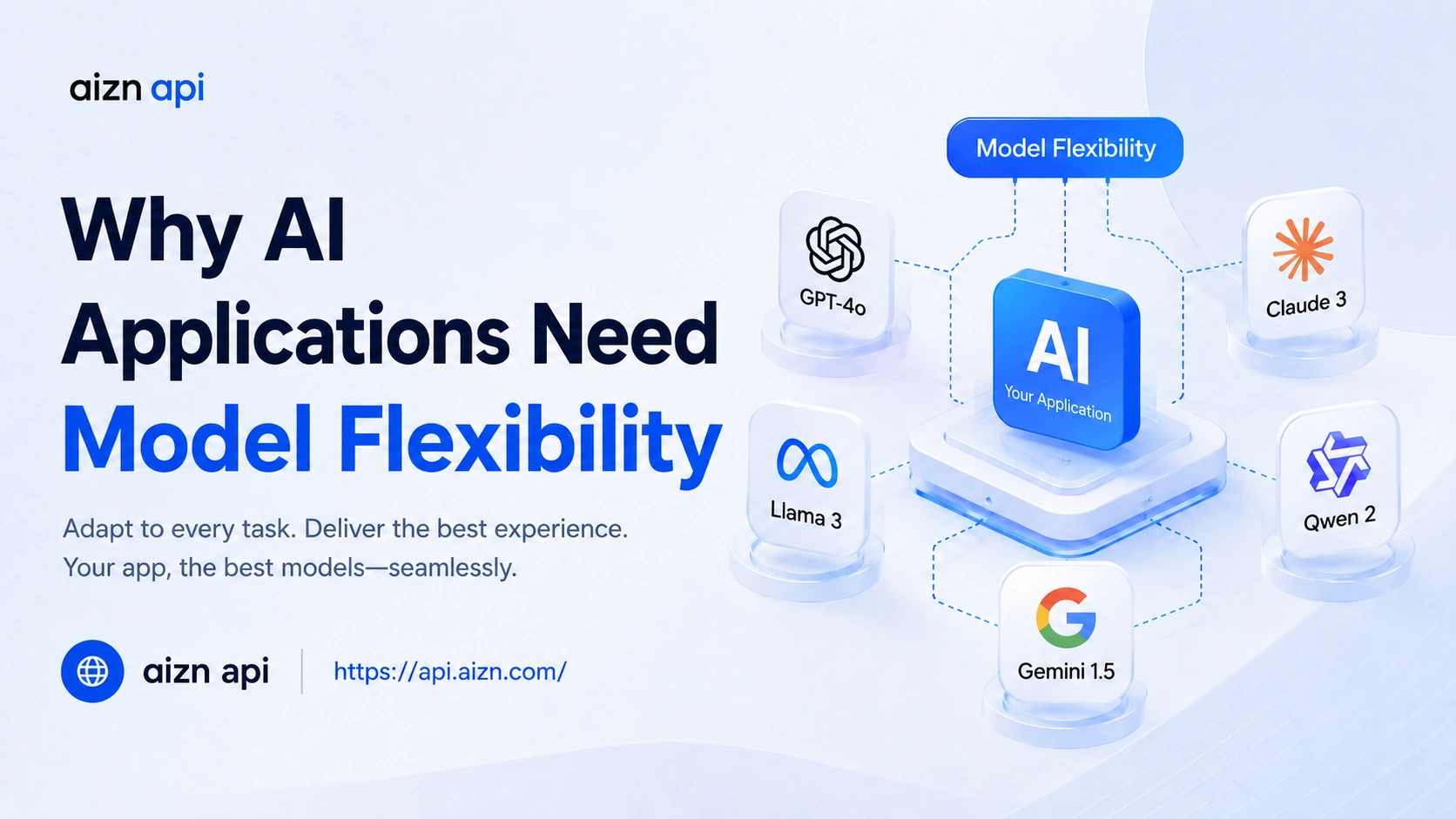
Why AI Applications Need Infrastructure Flexibility
AI changes extremely quickly.
New models appear constantly.
Performance changes rapidly.
Pricing structures evolve.
Applications built with rigid infrastructure may struggle to adapt.
Flexible AI systems allow developers to:
- experiment faster
- reduce migration risk
- improve reliability
- optimize infrastructure continuously
This becomes critical for long-term scalability.
Why AI SaaS Products Depend on Multi-Model Systems
AI SaaS companies face additional complexity because customer workloads vary significantly.
Different customers may require:
- different latency levels
- different reasoning quality
- different language support
- different token budgets
- different automation workflows
A flexible AI infrastructure makes these requirements easier to support.
This is one reason many AI SaaS platforms are moving toward Unified LLM APIs.
Why API AIZN Helps Developers Build Flexible AI Infrastructure
API AIZN provides Unified LLM API infrastructure and AI Gateway systems for developers building multi-model AI applications.
Instead of rebuilding integrations for every provider, developers can use API AIZN to manage:
- multi-model AI access
- AI routing systems
- scalable AI workflows
- cost optimization
- provider flexibility
- AI Agent infrastructure
This allows teams to focus more on products and less on provider management complexity.
API AIZN Infrastructure Capabilities
✔ Unified LLM API access
✔ Multi-model AI infrastructure
✔ AI Gateway systems
✔ Provider routing logic
✔ Scalable AI workflows
✔ AI Agent integration
✔ Flexible API architecture
This helps developers build more adaptable AI systems.
Why This Matters for the Future of AI Development
The AI industry is still evolving rapidly.
The strongest infrastructure strategies are no longer based on:
choosing one permanent model.
Instead, modern AI systems increasingly prioritize:
- flexibility
- routing intelligence
- provider abstraction
- scalable orchestration
- multi-model adaptability
This creates stronger long-term infrastructure resilience.
FAQ
What is multi-model AI infrastructure?
Multi-model AI infrastructure allows applications to access and manage multiple AI models inside one system.
Why are developers moving away from single-model AI?
Because different models perform differently across cost, latency, reasoning, and scalability requirements.
What is a Unified LLM API?
A Unified LLM API provides access to multiple AI providers through one API integration.
What does an AI Gateway do?
An AI Gateway manages routing, provider orchestration, token monitoring, and scalable AI workflows.
What is API AIZN?
API AIZN is a Unified LLM API and AI Gateway platform that helps developers build flexible multi-model AI infrastructure.
Conclusion
The future of AI infrastructure is becoming increasingly multi-model.
As AI applications grow more complex, flexibility matters more than dependency on one provider.
Developers who build adaptable infrastructure today will be better prepared for:
- changing models
- evolving pricing
- scaling workloads
- future AI workflows
because modern AI systems increasingly require orchestration — not just model access.
The future of AI development belongs to flexible multi-model infrastructure.