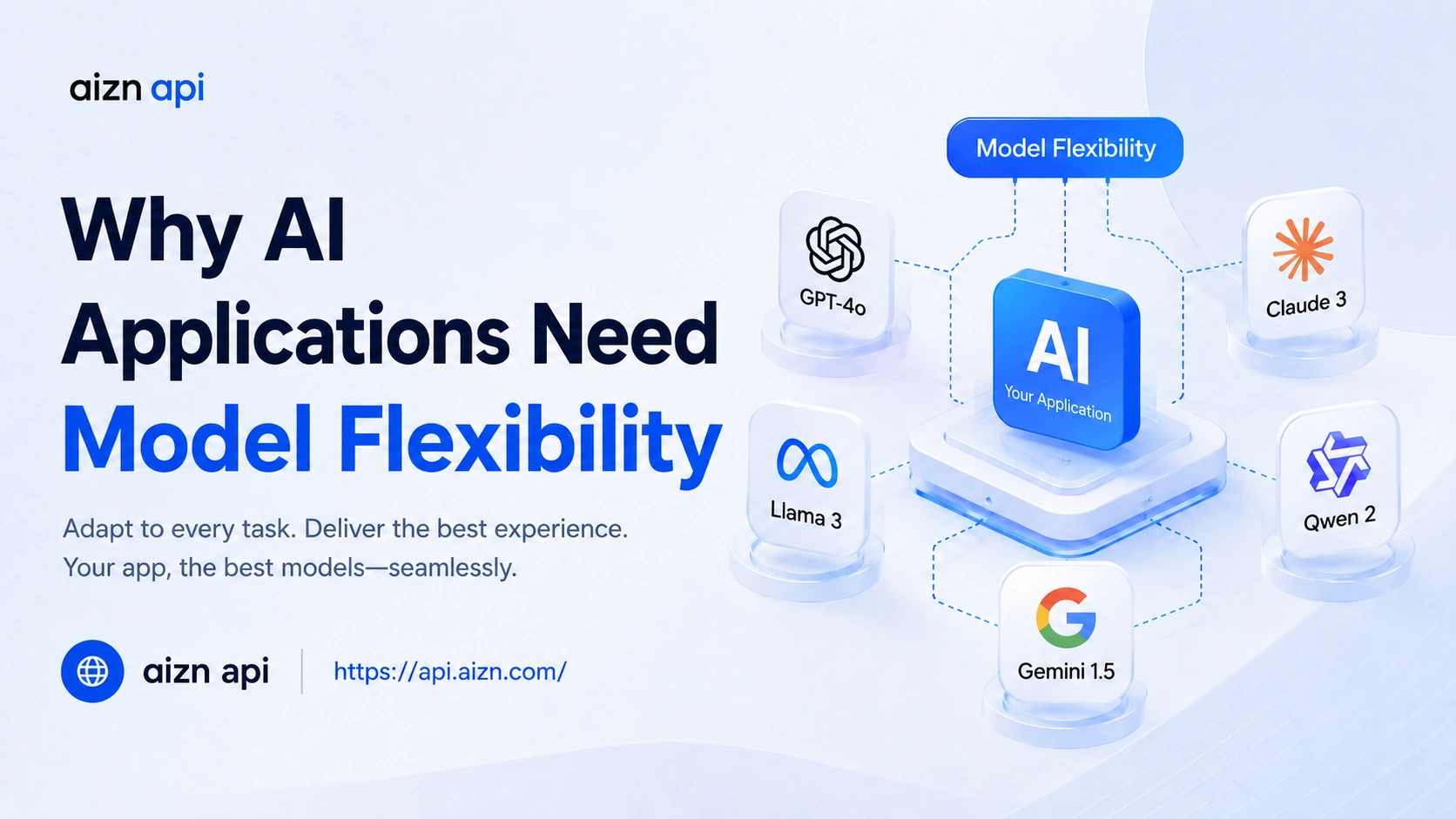
Many AI applications start with one model.
A team chooses a provider, connects the API, builds the first workflow, and ships the feature.
At the beginning, this feels simple.
But as the product grows, the team often needs:
- lower-cost inference
- stronger reasoning
- faster response speed
- long-context support
- better reliability
- backup provider options
At that point, the challenge is no longer only about choosing the best model.
The real challenge becomes:
Can the application adapt when model requirements change?
This is why model flexibility is becoming a core requirement for modern AI application infrastructure.
The Model You Choose Today May Not Be the Best Model Tomorrow
AI changes quickly.
A model that performs well today may later become:
- too expensive
- too slow
- less competitive
- unsuitable for new workflows
- limited for enterprise requirements
This does not mean the original model was the wrong choice.
It means AI infrastructure should not depend entirely on one permanent provider.
Modern AI applications need room to evolve.
Single-Model Systems Create Hidden Problems
Single-model systems often look efficient at first.
But over time, they can create hidden limitations.
Teams may face:
- provider dependency
- difficult model switching
- limited routing flexibility
- higher infrastructure risk
- slower experimentation
- weaker cost optimization
The more an AI product scales, the more these limitations matter.
The Better Question Developers Should Ask
Many teams ask:
Which model should we use?
That question matters.
But another question matters more:
How easily can we switch, route, or compare models later?
That second question defines infrastructure flexibility.
It affects:
- product speed
- reliability
- operating cost
- scaling strategy
- long-term adaptability
Strong AI systems are not built around one fixed model.
They are built around flexible infrastructure.
What Is Model Flexibility?
Model flexibility means an AI application can access, switch, or combine different AI models without major backend changes.
A model-flexible system allows teams to:
- test new providers
- route different workloads
- reduce dependency risk
- optimize token usage
- improve performance
- adapt to changing model capabilities
This is especially important for AI SaaS products, AI Agents, and high-volume automation systems.
Why Different Workloads Need Different Models
Not every AI task requires the same model.
| Workload | Better Infrastructure Choice |
|---|---|
| Simple automation | Lower-cost model routing |
| Complex reasoning | Stronger reasoning model |
| Long documents | Long-context model support |
| High-volume tasks | Cost-efficient inference |
| Production workflows | Fallback provider support |
One model rarely fits every workload equally well.
Model flexibility allows teams to match the right model to the right task.
What Is a Unified LLM API?
A Unified LLM API lets developers access multiple AI models through one API layer.
Instead of building separate integrations for:
- OpenAI
- Claude
- Gemini
- DeepSeek
- Mistral
- Llama
developers connect once through a unified interface.
This makes model switching, routing, and usage management much easier.
Why an AI Gateway Matters
An AI Gateway sits between your application and different model providers.
It helps manage:
- provider access
- model routing
- token usage
- fallback logic
- request handling
- infrastructure flexibility
Without an AI Gateway, every provider becomes another integration to maintain.
With an AI Gateway, applications become less dependent on any single model.
Model Flexibility vs Model Dependency
| Model Dependency | Model Flexibility |
|---|---|
| One provider controls the stack | Multiple providers remain accessible |
| Switching is difficult | Switching becomes easier |
| Cost optimization is limited | Routing can improve efficiency |
| Infrastructure becomes rigid | Infrastructure remains adaptable |
| Scaling requires rewrites | Scaling becomes more manageable |
The strongest AI applications are not only choosing good models.
They are building systems that can adapt.
Why Model Flexibility Matters for AI SaaS Products
AI SaaS products rarely serve one fixed workload forever.
As customers grow, teams may need to support:
- different latency needs
- different reasoning levels
- different token budgets
- different workflow types
- different language requirements
A flexible AI infrastructure makes these requirements easier to support.
It also reduces the risk of being locked into one provider’s pricing, speed, or roadmap.
Why Model Flexibility Matters for AI Agents
AI Agents often perform multi-step workflows.
One Agent may need to:
- understand a user request
- analyze data
- browse a website
- generate structured output
- write follow-up content
- summarize results
Different steps may benefit from different models.
A rigid single-model setup can limit Agent performance and efficiency.
A flexible AI Gateway gives AI Agents more room to scale.
How API AIZN Helps Developers Build Model-Flexible AI Applications
API AIZN provides Unified LLM API and AI Gateway infrastructure for developers building flexible AI applications.
With API AIZN, teams can access multiple models through one API layer instead of rebuilding integrations every time they want to test or switch providers.
API AIZN helps developers build:
- model-flexible AI apps
- multi-model AI workflows
- scalable AI SaaS products
- AI Agent infrastructure
- cost-aware API systems
- provider-flexible AI architecture
The goal is simple:
keep AI applications adaptable.
API AIZN Capabilities
✔ Unified LLM API access
✔ AI Gateway infrastructure
✔ Multi-model AI support
✔ Flexible model switching
✔ Scalable AI workflows
✔ AI Agent infrastructure
✔ Cost-aware API architecture
This helps developers reduce infrastructure friction while improving long-term scalability.
FAQ
What is model flexibility in AI applications?
Model flexibility means an AI application can switch, route, or combine different AI models without major backend changes.
Why is model flexibility important?
Because model pricing, speed, quality, and capabilities change quickly. Flexible infrastructure helps applications adapt.
What is a Unified LLM API?
A Unified LLM API lets developers access multiple AI providers through one API layer.
What does an AI Gateway do?
An AI Gateway manages provider access, routing, fallback logic, token usage, and scalable AI workflows.
What is API AIZN?
API AIZN is a Unified LLM API and AI Gateway platform that helps developers build flexible multi-model AI applications.
Conclusion
Choosing the right AI model matters.
But building flexible infrastructure matters even more.
Models will change.
Pricing will change.
Application requirements will change.
Developers who rely on rigid single-provider systems may struggle to adapt.
The future belongs to AI applications built on flexible, unified, multi-model API infrastructure.
In AI development, flexibility is not optional. It is infrastructure strategy.

