The AI industry moves extremely fast.
New models appear constantly.
Capabilities improve every few months.
Pricing changes frequently.
Because of this, many companies focus heavily on:
- model quality
- prompts
- AI features
- automation workflows
But underneath all of these systems, another layer is quietly becoming more important:
AI infrastructure.
As AI applications scale, infrastructure increasingly determines:
- reliability
- flexibility
- operating cost
- scalability
- development speed
- long-term adaptability
The strongest AI companies are no longer competing only on models.
They are competing on infrastructure architecture.
The AI Layer Most Companies Ignore
Early-stage AI products often begin with simple API connections.
One provider.
One workflow.
One integration.
At small scale, this works.
But as applications grow, infrastructure complexity increases rapidly.
Teams begin dealing with:
- model routing
- token management
- provider instability
- scaling workflows
- latency optimization
- multi-model orchestration
At that point, infrastructure becomes a strategic layer — not just an engineering detail.
Why Models Alone Are No Longer Enough
Different AI models are optimized for different tasks.
For example:
| AI Requirement | Better Infrastructure Need |
|---|---|
| Low latency | Fast routing systems |
| Cost control | Flexible provider selection |
| Long-context workflows | Dynamic model orchestration |
| Enterprise scalability | Stable infrastructure layers |
| AI Agents | Multi-model execution systems |
A powerful model without scalable infrastructure creates operational limitations.
That is why infrastructure flexibility is becoming a competitive advantage.
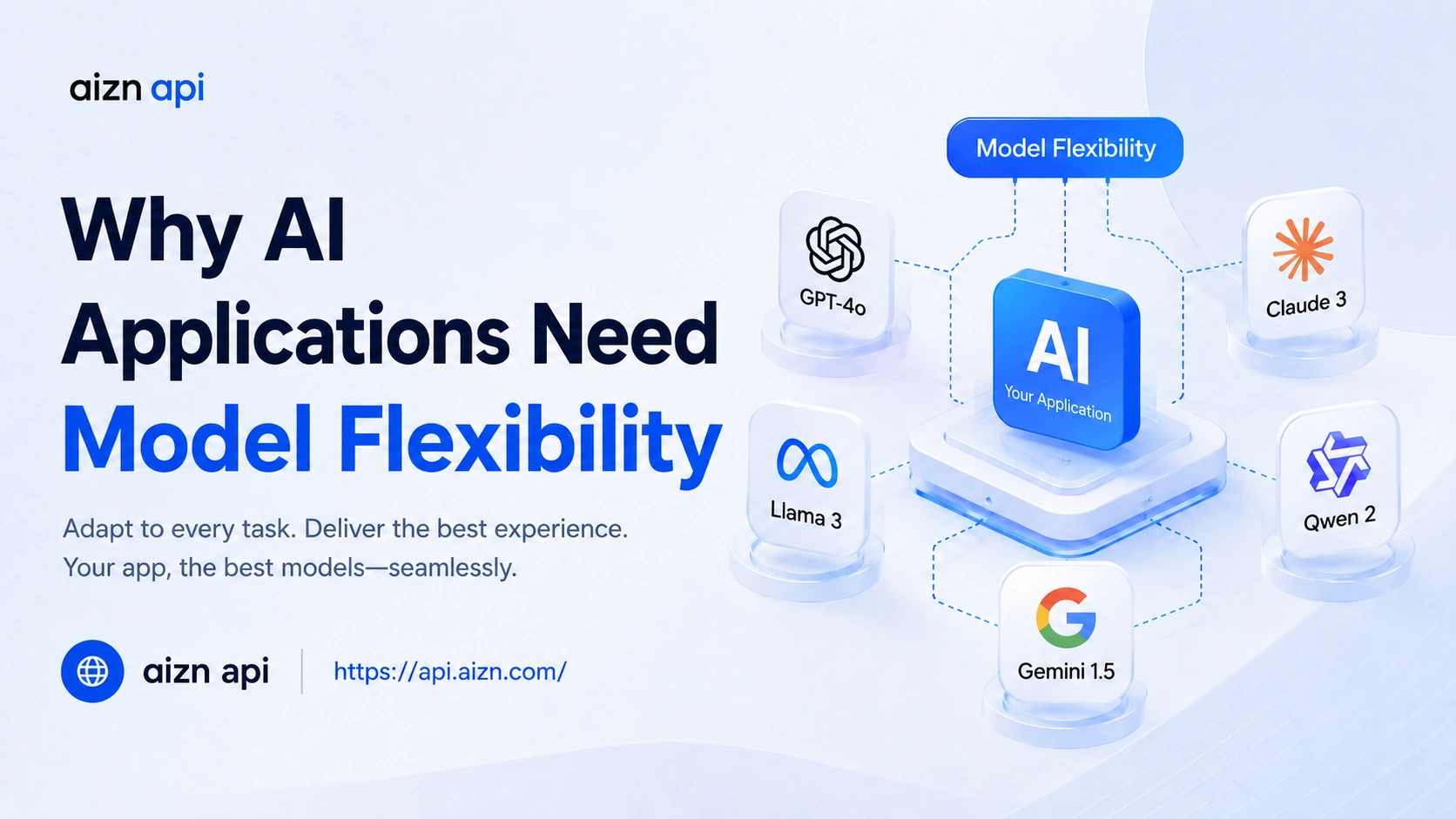
The Industry Is Moving Toward Multi-Model Systems
Many AI companies originally built products around one provider.
But over time, this creates dependency risks.
A provider may change:
- pricing
- rate limits
- API structures
- model behavior
- usage policies
Modern AI products increasingly need the ability to:
✔ switch providers
✔ route workloads
✔ optimize costs
✔ balance performance
✔ scale workflows dynamically
This is one reason Unified LLM APIs are growing quickly.
What Is a Unified LLM API?
A Unified LLM API allows developers to access multiple AI providers through one API structure.
Instead of separately managing:
- OpenAI APIs
- Claude APIs
- Gemini APIs
- DeepSeek APIs
- other model providers
developers integrate once through a unified infrastructure layer.
This dramatically simplifies AI operations.
Why AI Gateway Systems Matter
As AI workflows become more complex, orchestration becomes critical.
An AI Gateway helps manage:
- provider routing
- fallback logic
- token monitoring
- request balancing
- model selection
- workflow scalability
Without orchestration infrastructure, scaling AI systems becomes difficult very quickly.
AI Infrastructure Is Now an Operational Layer
AI systems are no longer isolated tools.
Modern AI applications increasingly behave like operational platforms.
They involve:
- AI Agents
- workflow automation
- browser execution
- multi-step orchestration
- structured generation
- enterprise pipelines
This creates infrastructure demands similar to large-scale software systems.
AI infrastructure is becoming:
the operating system behind modern AI applications.
Why Infrastructure Flexibility Creates Competitive Advantages
Flexible infrastructure allows teams to adapt faster.
For example:
- switching providers becomes easier
- experimenting with new models becomes faster
- scaling workloads becomes more stable
- infrastructure costs become easier to optimize
Rigid AI systems struggle to evolve.
Flexible AI systems adapt continuously.
This difference becomes larger over time.
AI Infrastructure vs Basic AI Integration
| Basic AI Integration | Scalable AI Infrastructure |
|---|---|
| One provider | Multi-model systems |
| Static workflows | Dynamic orchestration |
| Manual scaling | Infrastructure automation |
| Limited routing | Flexible workload balancing |
| API dependency | Provider abstraction |
The future increasingly belongs to adaptable infrastructure systems.
Why AI SaaS Companies Depend on Infrastructure
AI SaaS platforms face continuous infrastructure pressure.
As customers grow, products need to support:
- larger workloads
- lower latency
- higher reliability
- more automation
- more model flexibility
This becomes difficult without scalable architecture.
Infrastructure quality increasingly affects:
- user experience
- operating margins
- scalability
- product stability
This is why infrastructure is becoming strategic.
Why AI Agents Accelerate Infrastructure Complexity
AI Agents create even more infrastructure requirements.
Modern Agent systems may involve:
- browser execution
- workflow orchestration
- multi-step reasoning
- API coordination
- memory systems
- external tool integration
These systems require:
- routing logic
- orchestration layers
- scalable execution pipelines
- multi-model infrastructure
AI Agents are pushing infrastructure evolution even faster.
Why API AIZN Helps Developers Build Scalable AI Infrastructure
API AIZN provides Unified LLM APIs and AI Gateway systems designed for scalable AI applications.
With API AIZN, developers can build:
- multi-model AI systems
- scalable AI Agent infrastructure
- provider-flexible applications
- orchestration workflows
- routing-based AI systems
- enterprise AI pipelines
without rebuilding integrations for every provider.
This allows teams to focus more on products and less on infrastructure fragmentation.
API AIZN Infrastructure Capabilities
✔ Unified LLM API access
✔ AI Gateway orchestration
✔ Multi-model AI infrastructure
✔ Scalable AI workflows
✔ Provider abstraction systems
✔ AI Agent infrastructure
✔ Flexible API architecture
This helps developers build more adaptable AI systems.
Why This Matters for the Future of AI
The AI industry will continue evolving rapidly.
Models will improve.
Providers will change.
Workflows will become more complex.
The companies that scale successfully will increasingly be the ones with infrastructure capable of adapting continuously.
Because long-term AI advantage will depend less on one specific model…
and more on:
- orchestration
- flexibility
- infrastructure scalability
- provider adaptability
- workflow resilience
FAQ
Why is AI infrastructure becoming important?
Because scalable AI applications increasingly require routing, orchestration, provider flexibility, and multi-model execution systems.
What is a Unified LLM API?
A Unified LLM API allows developers to access multiple AI providers through one infrastructure layer.
What does an AI Gateway do?
An AI Gateway manages provider routing, orchestration, token monitoring, and scalable AI workflows.
Why are multi-model systems important?
Different AI models perform better across different tasks, making flexible infrastructure more scalable.
What is API AIZN?
API AIZN is a Unified LLM API and AI Gateway platform that helps developers build scalable AI infrastructure.
Conclusion
AI products are becoming increasingly infrastructure-driven.
The next competitive advantage is no longer only:
- model quality
- prompts
- feature lists
It is infrastructure flexibility.
The companies that build adaptable AI systems today will be better prepared for future:
- models
- workflows
- scaling demands
- automation systems
- AI Agent ecosystems
because modern AI increasingly depends on orchestration — not just intelligence.
In the next phase of AI, infrastructure becomes strategy.