AI Agents are becoming more capable very quickly.
Modern AI Agents can already:
- browse websites
- execute workflows
- generate reports
- automate operations
- process documents
- coordinate tasks
- interact with external tools
But as AI Agents become more powerful, one challenge becomes increasingly obvious:
AI Agents are extremely infrastructure-dependent.
Many developers focus heavily on:
- prompts
- workflows
- reasoning models
- automation logic
while underestimating the importance of API infrastructure.
In reality, scalable AI Agents require much more than access to one model.
They require:
- routing systems
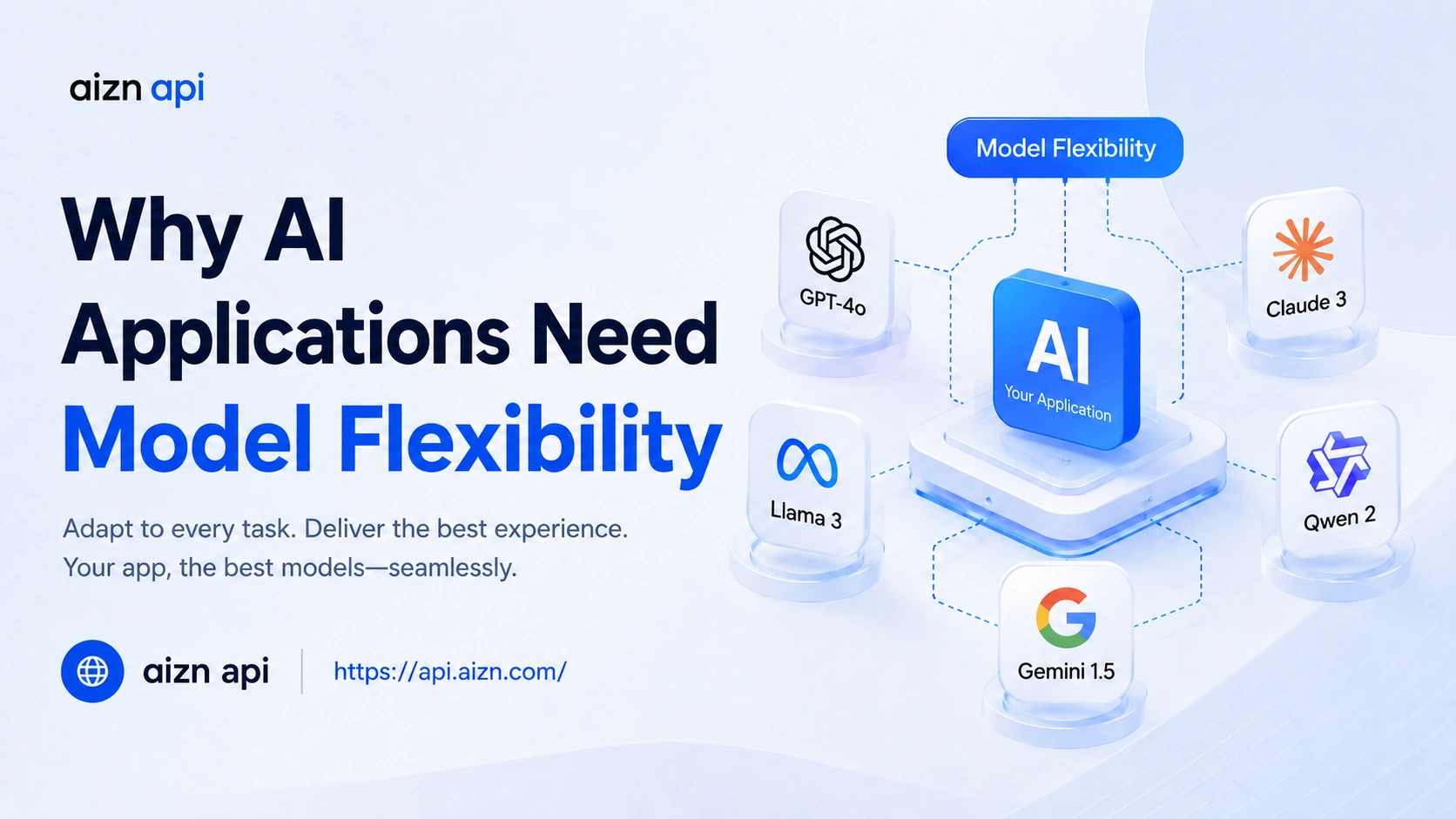
- model flexibility
- orchestration layers
- scalable API workflows
- provider abstraction
This is why Unified API infrastructure is becoming essential for AI Agent systems.
AI Agents Rarely Depend on One Model
Different Agent tasks require different capabilities.
For example:
| AI Agent Task | Better Model Characteristics |
|---|---|
| Fast automation | Lower latency |
| Browser reasoning | Strong decision-making |
| Long workflows | Larger context windows |
| Content generation | Better writing quality |
| Data extraction | Structured output reliability |
A single provider rarely performs best across every task.
As AI Agent systems grow more complex, developers increasingly need:
multi-model orchestration.
Why Single-Provider AI Agents Become Fragile
Many early AI Agent systems were built directly on one provider.
This creates several long-term problems.
Problem 1: Model Dependency
If one provider changes:
- pricing
- rate limits
- model quality
- API structure
the entire Agent workflow may be affected.
Problem 2: Limited Optimization
Different tasks may require:
- different reasoning strengths
- different latency levels
- different inference costs
Single-model systems limit optimization flexibility.
Problem 3: Scaling Complexity
As Agent systems grow, developers often need:
- fallback providers
- routing logic
- workload balancing
- token monitoring
Without infrastructure abstraction, this becomes difficult to manage.
What Unified API Infrastructure Actually Solves
Unified API infrastructure allows AI Agents to interact with multiple AI providers through one system.
Instead of separately managing:
- OpenAI APIs
- Claude APIs
- Gemini APIs
- DeepSeek APIs
- other LLM integrations
developers use one unified orchestration layer.
This dramatically simplifies Agent scalability.
What Is a Unified LLM API?
A Unified LLM API allows applications and AI Agents to access multiple AI providers using one API structure.
This helps developers:
✔ switch models more easily
✔ reduce integration complexity
✔ improve routing flexibility
✔ scale workflows faster
✔ reduce provider dependency
For AI Agents, this flexibility becomes extremely important.
Why AI Gateway Systems Matter for AI Agents
An AI Gateway acts as the infrastructure layer between AI Agents and model providers.
It helps manage:
- provider routing
- fallback systems
- token usage
- workflow orchestration
- multi-model execution
- scalability monitoring
Without an AI Gateway, large Agent systems become increasingly difficult to maintain.
AI Agents Need Routing Logic
Not every Agent task needs the same model.
For example:
- quick automation may use lower-cost models
- complex reasoning may require stronger models
- browser Agents may prioritize response speed
- document workflows may need larger context windows
Routing logic helps optimize:
✔ performance
✔ cost
✔ scalability
✔ reliability
This is becoming a core part of modern AI infrastructure.
AI Agent Infrastructure vs Simple AI Automation
| Simple AI Automation | AI Agent Infrastructure |
|---|---|
| Single workflow | Multi-step orchestration |
| One provider | Multi-model systems |
| Limited scalability | Flexible infrastructure |
| Static execution | Dynamic routing |
| Basic prompts | Operational orchestration |
The future increasingly belongs to scalable Agent systems.
Why AI Agents Require Infrastructure Flexibility
AI Agents continuously evolve.
As products grow, teams may need to adjust:
- model routing
- inference strategy
- token allocation
- provider selection
- workflow orchestration
Rigid infrastructure slows down experimentation.
Flexible API systems make adaptation easier.
Why Multi-Model AI Matters for Agent Systems
AI Agents increasingly combine:
- reasoning
- automation
- memory
- execution
- browser interaction
- structured generation
Different providers often perform better across different capabilities.
Multi-model systems allow developers to:
- optimize workloads
- reduce operational risk
- improve workflow quality
- build more resilient infrastructure
This becomes increasingly important for enterprise AI systems.
Why API AIZN Helps Developers Build Scalable AI Agents
API AIZN provides Unified LLM APIs and AI Gateway infrastructure designed for scalable AI Agent systems.
With API AIZN, developers can build:
- multi-model AI workflows
- scalable AI Agent orchestration
- provider-flexible infrastructure
- routing-based automation systems
- AI browser workflows
- enterprise AI pipelines
without rebuilding integrations for every provider.
This dramatically simplifies AI infrastructure management.
API AIZN Infrastructure Capabilities
✔ Unified LLM API access
✔ AI Gateway orchestration
✔ Multi-model AI routing
✔ Scalable AI Agent workflows
✔ Provider abstraction systems
✔ Enterprise AI infrastructure
✔ Flexible API architecture
This helps developers build more adaptable AI Agent systems.
Why This Matters for the Future of AI Agents
The future of AI Agents is not only about smarter reasoning.
It is also about:
- infrastructure flexibility
- orchestration scalability
- provider abstraction
- routing intelligence
- workflow adaptability
The strongest Agent systems will increasingly depend on infrastructure capable of evolving alongside AI models.
FAQ
Why do AI Agents need Unified APIs?
Because AI Agents often require multiple models, routing flexibility, and scalable infrastructure orchestration.
What is a Unified LLM API?
A Unified LLM API allows developers to access multiple AI providers through one API layer.
What does an AI Gateway do?
An AI Gateway manages routing, orchestration, provider abstraction, and scalable workflow execution.
Why are multi-model systems important for AI Agents?
Different AI models perform better across different tasks such as reasoning, automation, and long-context workflows.
What is API AIZN?
API AIZN is a Unified LLM API and AI Gateway platform that helps developers build scalable AI Agent infrastructure.
Conclusion
AI Agents are becoming operational systems, not just prompt workflows.
As Agent complexity grows, infrastructure flexibility becomes increasingly important.
Developers who continue relying on rigid single-provider systems may struggle to scale future Agent workflows effectively.
The future increasingly belongs to AI Agent systems built on:
- Unified LLM APIs
- AI Gateway infrastructure
- multi-model orchestration
- flexible routing systems
- scalable AI workflows
because modern AI automation requires orchestration — not just model access.
Smarter AI Agents require smarter infrastructure.