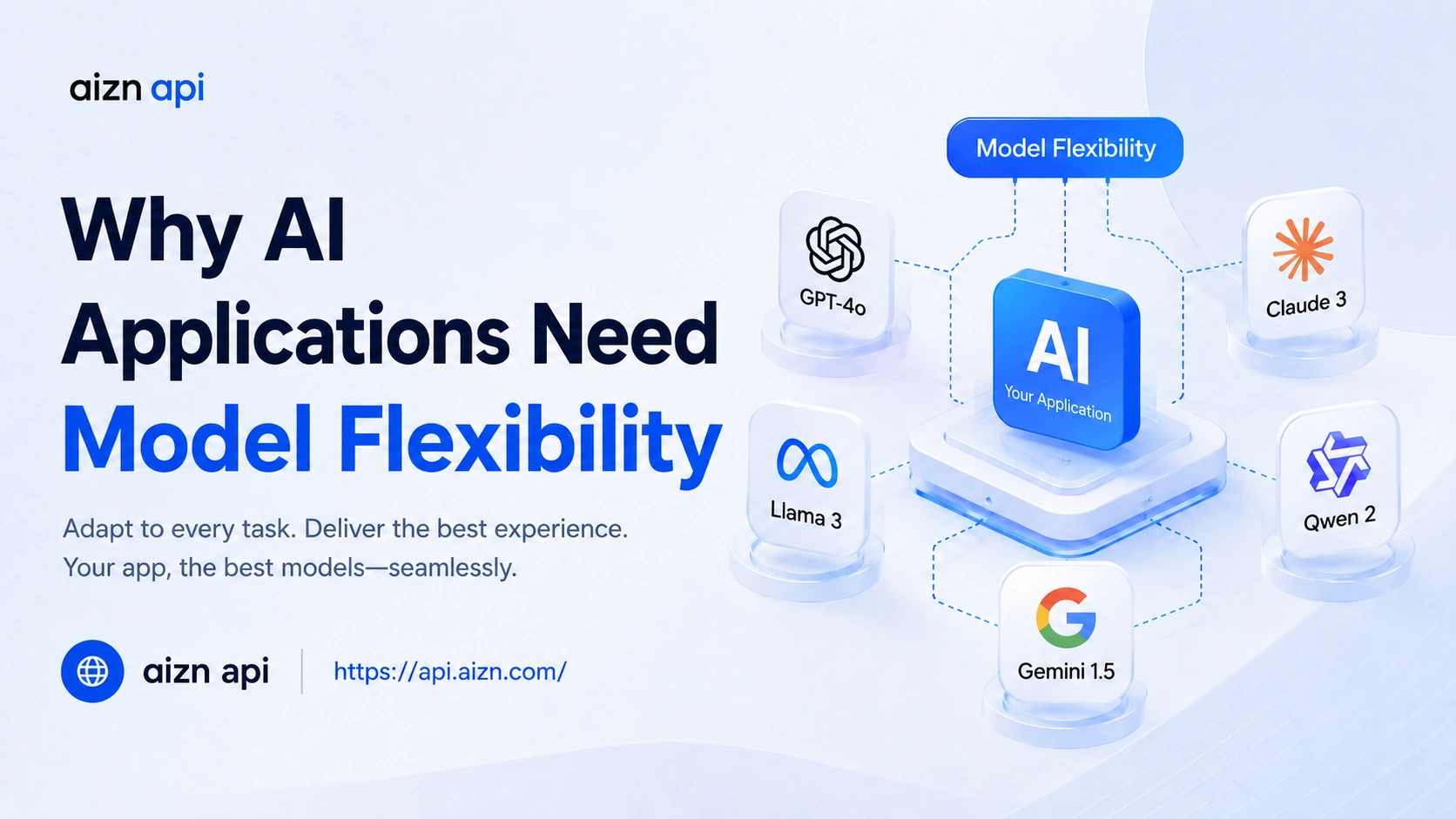
Most AI teams spend too much time asking one question:
Which model should we use?
OpenAI, Claude, Gemini, DeepSeek, Mistral, Llama — every model has different strengths.
But for serious AI applications, the more important question is:
Can our infrastructure switch models when needed?
Model quality changes quickly.
Pricing changes.
Latency changes.
New providers appear.
Use cases evolve.
That is why API flexibility is becoming more important than choosing one “perfect” model.
The Problem With Choosing One Model Too Early
Many developers start by building around one provider.
At first, this feels simple.
But later, the product grows.
The team needs:
- cheaper inference for simple tasks
- stronger reasoning for complex tasks
- long-context support for documents
- fallback options when a provider slows down
- different models for different workflows
At that point, a single-provider setup becomes limiting.
The issue is not the model.
The issue is the infrastructure.
AI Applications Need Room to Change
A modern AI application is rarely static.
Over time, teams may need to adjust:
- model selection
- prompt formats
- routing logic
- token usage
- performance requirements
- cost strategy
If every change requires backend rewrites, development slows down.
A flexible API layer makes experimentation easier.
What Is a Unified LLM API?
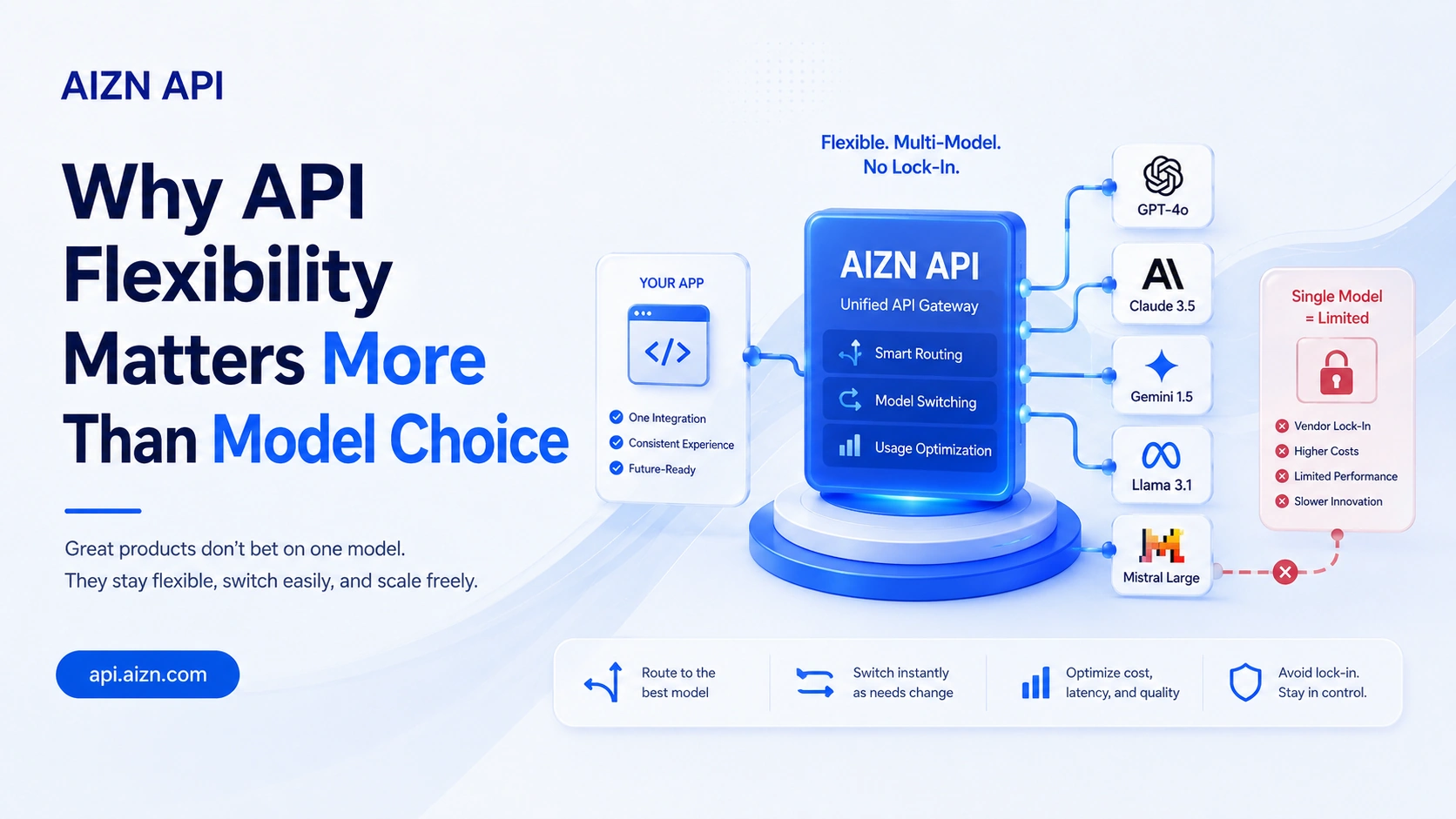
A Unified LLM API allows developers to access multiple AI models through one API integration.
Instead of separately managing:
- OpenAI API
- Claude API
- Gemini API
- DeepSeek API
- other model providers
developers connect to one unified gateway.
The gateway handles model access, provider abstraction, request routing, and usage management.
This makes AI infrastructure easier to scale.
Why AI Gateway Infrastructure Matters
An AI Gateway acts as the control layer between your application and multiple AI providers.
It helps teams manage:
- multi-model access
- request routing
- token usage
- provider switching
- fallback logic
- scalable API workflows
This reduces engineering complexity.
More importantly, it keeps the application flexible.
API Flexibility vs Model Dependency
| Model Dependency | API Flexibility |
|---|---|
| One provider controls the stack | Multiple models stay accessible |
| Switching is difficult | Switching is easier |
| Cost optimization is limited | Routing can improve efficiency |
| Infrastructure becomes rigid | Infrastructure remains adaptable |
| Scaling requires more rewrites | Scaling becomes more manageable |
The strongest AI teams are not only choosing good models.
They are building flexible systems.
Where API Flexibility Creates Real Value
API flexibility matters most when applications need to handle different task types.
For example:
- simple classification can use a lower-cost model
- complex reasoning may need a stronger model
- document workflows may need long-context models
- high-volume automation may need cost-efficient routing
- production systems may need fallback providers
One model rarely fits every workload perfectly.
A Unified LLM API gives developers more control.
Why This Matters for AI SaaS Products
AI SaaS products need predictable infrastructure.
If costs rise suddenly or a provider becomes unstable, the product team needs options.
Flexible AI infrastructure helps SaaS teams:
- reduce provider dependency
- test new models faster
- manage inference costs
- improve reliability
- support different customer use cases
This becomes more important as usage grows.
Why API AIZN Helps Developers Stay Flexible
API AIZN provides a Unified LLM API and AI Gateway infrastructure for developers building multi-model AI applications.
With API AIZN, teams can access multiple AI models through one API layer instead of rebuilding integrations for every provider.
API AIZN helps developers build:
- flexible AI applications
- scalable AI SaaS products
- multi-model AI workflows
- AI Agent systems
- cost-aware infrastructure
- provider-flexible API architecture
The goal is not to lock teams into one model.
The goal is to keep AI development adaptable.
FAQ
What is API flexibility in AI development?
API flexibility means your application can access, switch, and manage multiple AI models without major infrastructure changes.
Why is a Unified LLM API useful?
A Unified LLM API allows developers to connect once and access multiple AI providers through one API layer.
What is an AI Gateway?
An AI Gateway is an infrastructure layer that manages routing, provider access, token usage, and multi-model workflows.
Why should developers avoid single-model dependency?
Single-model dependency can create cost, reliability, and scalability risks as AI applications grow.
What is API AIZN?
API AIZN is a Unified LLM API and AI Gateway platform that helps developers build flexible multi-model AI applications.
Conclusion
Choosing the right AI model matters.
But building flexible infrastructure matters more.
Models will keep changing.
Pricing will keep changing.
Application needs will keep changing.
Developers who rely on rigid single-provider systems may struggle to adapt.
The future belongs to AI applications built on flexible, unified, multi-model API infrastructure.
In modern AI development, flexibility is the real advantage.