AI applications are becoming increasingly mission-critical.
Modern AI systems now power:
- customer support
- AI Agents
- workflow automation
- enterprise operations
- AI copilots
- SaaS platforms
- research systems
- autonomous workflows
As businesses rely more heavily on AI, infrastructure reliability becomes extremely important.
At the same time, modern AI systems increasingly depend on multiple providers such as:
- OpenAI
- Claude
- Gemini
- DeepSeek
- Mistral
- Llama
Managing reliability across multiple providers creates significant engineering complexity.
This is why Unified AI Gateways are becoming essential infrastructure for scalable AI systems.
Why AI Reliability Matters
AI applications increasingly operate in production environments.
Downtime can directly affect:
- customer experience
- business operations
- workflow execution
- revenue generation
- enterprise automation
As AI adoption grows, businesses increasingly require:
✔ stable infrastructure
✔ scalable orchestration
✔ provider redundancy
✔ failover systems
✔ flexible routing
✔ operational resilience
Modern AI infrastructure must support continuous availability.
Problems With Single-Provider AI Systems
Many AI applications initially rely on one provider.
Examples include:
- OpenAI-only systems
- Claude-only applications
- Gemini-only workflows
While this simplifies early development, it creates several reliability risks at scale.
❌ Provider Outages
If one provider experiences:
- downtime
- API instability
- latency spikes
- infrastructure failures
applications may stop functioning completely.
❌ Rate Limits
High traffic can trigger provider-side limitations.
This creates performance bottlenecks for growing applications.
❌ Infrastructure Dependency
Applications become tightly dependent on one provider’s:
- infrastructure quality
- availability
- scaling capabilities
- operational stability
This increases operational risk.
❌ Limited Failover Capabilities
Without orchestration systems, applications cannot dynamically reroute requests when failures occur.
The Solution: Unified AI Gateways
Unified AI Gateways improve reliability by creating:
centralized multi-provider infrastructure.
Instead of relying on one provider:
Applications dynamically access multiple AI models through one orchestration layer.
This dramatically improves infrastructure resilience.
What Is a Unified AI Gateway?
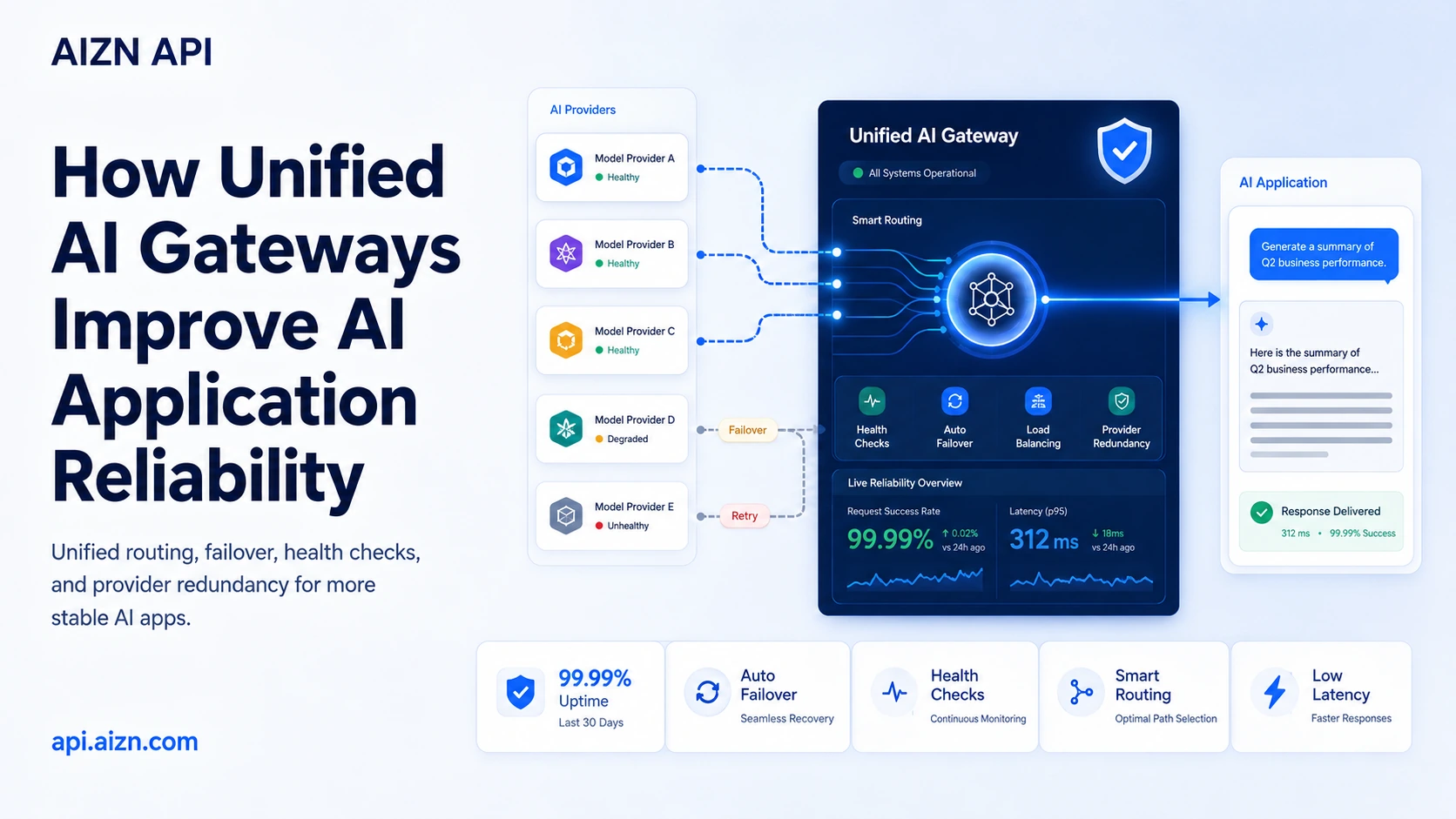
A Unified AI Gateway is a centralized infrastructure layer that manages communication between applications and multiple AI providers.
Instead of integrating providers separately:
Application → AI Gateway → Multiple AI Models
The gateway handles:
- provider abstraction
- model routing
- failover systems
- API normalization
- orchestration workflows
- token management
This significantly improves reliability and scalability.
What Is a Unified LLM API?
A Unified LLM API allows applications to access multiple AI models through one standardized API system.
Instead of separately managing:
- OpenAI API
- Claude API
- Gemini API
- DeepSeek API
developers integrate once with:
one unified orchestration layer.
This simplifies infrastructure dramatically.
How AI Gateways Improve Reliability
Modern AI Gateways improve reliability through several critical systems.
1. Multi-Provider Redundancy
Applications can dynamically switch providers when one system becomes unstable.
This improves uptime significantly.
2. Failover Routing
If one model experiences issues, requests can automatically reroute to alternative providers.
This improves operational continuity.
3. Dynamic Load Distribution
Gateways can distribute workloads across multiple providers.
This reduces infrastructure bottlenecks.
4. Centralized Orchestration
Unified orchestration simplifies:
- monitoring
- routing
- infrastructure scaling
- operational management
This improves long-term maintainability.
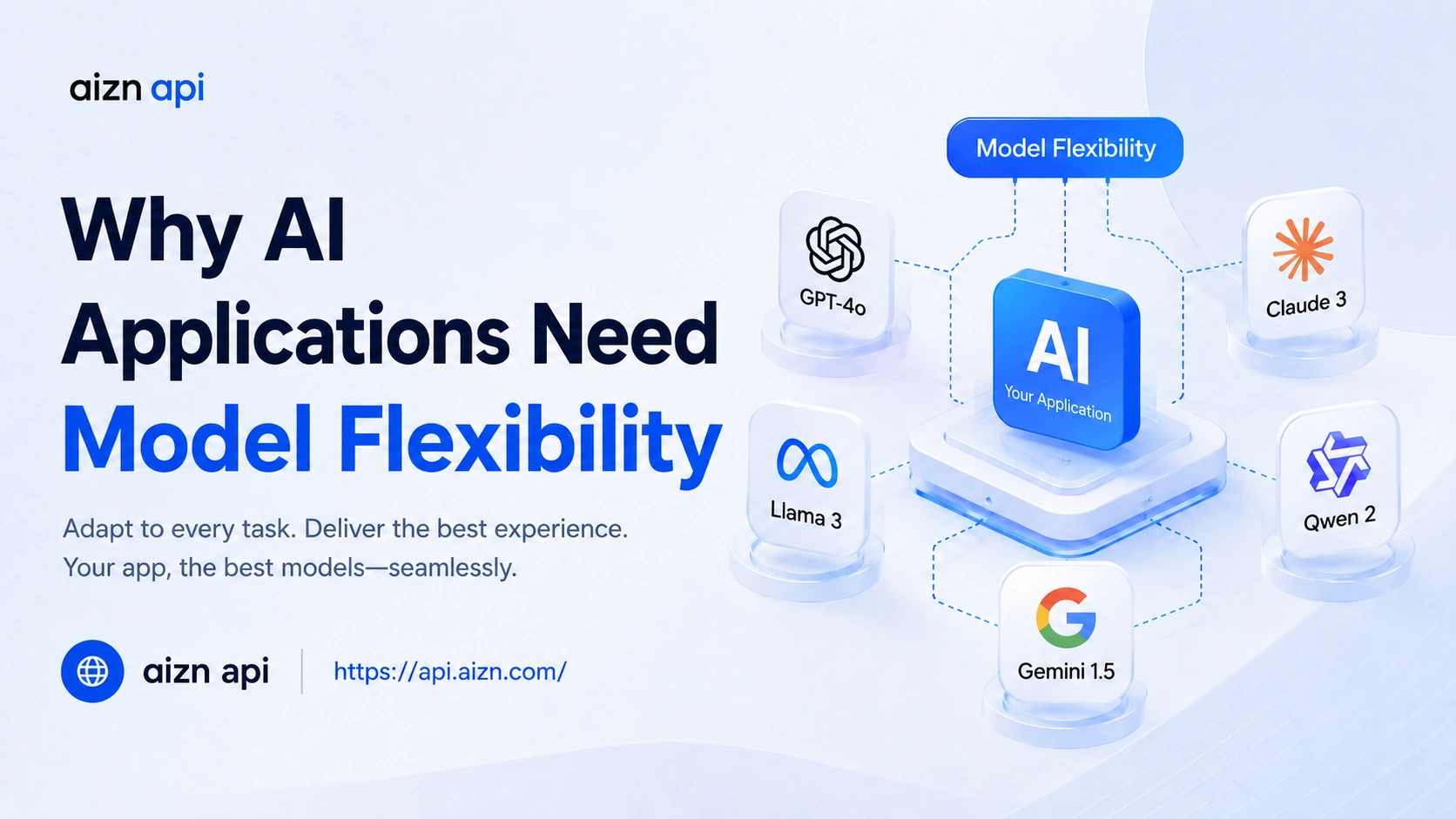
5. Infrastructure Flexibility
Applications can rapidly adapt to:
- new models
- pricing changes
- provider instability
- inference optimization opportunities
This dramatically improves scalability.
Why Multi-Model AI Improves Stability
Different AI providers have different infrastructure strengths.
For example:
| Provider Type | Common Strength |
|---|---|
| GPT models | General reasoning |
| Claude models | Long-context reliability |
| Gemini models | Multimodal systems |
| DeepSeek models | Cost-efficient inference |
| Open-source models | Deployment flexibility |
Multi-model systems improve resilience by avoiding single-provider dependency.
AI Gateways vs Direct Provider Integration
| Direct AI APIs | Unified AI Gateways |
|---|---|
| Single-provider dependency | Multi-provider redundancy |
| Manual failover | Automated routing |
| Infrastructure fragmentation | Centralized orchestration |
| Limited scalability | Scalable resilience |
| Higher operational risk | Flexible infrastructure |
The future increasingly belongs to resilient orchestration systems.
Why Reliability Matters for AI Agents
Modern AI Agents increasingly execute:
- autonomous workflows
- enterprise automation
- browser operations
- multi-step reasoning tasks
- customer-facing operations
Reliability failures can interrupt entire automation pipelines.
Unified infrastructure dramatically improves AI Agent stability.
Common Use Cases for Unified AI Reliability Systems
Unified AI Gateways increasingly support:
AI Agents
workflow automation
enterprise AI systems
AI SaaS platforms
customer support AI
AI copilots
research systems
large-scale AI operations
The larger the AI system becomes, the more important infrastructure reliability becomes.
How API AIZN Improves AI Infrastructure Reliability
API AIZN Official Website provides a Unified AI Gateway platform designed for scalable and reliable multi-model AI infrastructure.
API AIZN helps developers access:
- OpenAI
- Claude
- Gemini
- DeepSeek
- multiple AI providers
through one centralized orchestration system.
API AIZN Capabilities
✔ Unified LLM API
✔ Multi-model AI access
✔ Dynamic routing systems
✔ AI Gateway infrastructure
✔ Failover orchestration
✔ Centralized token management
✔ Scalable AI operations
This helps developers build more reliable AI systems at scale.
Why Early Reliability Planning Matters
AI systems are becoming increasingly infrastructure-intensive.
Businesses that adopt scalable orchestration early can:
- improve uptime
- reduce operational risk
- improve infrastructure flexibility
- scale AI systems faster
- reduce provider dependency
Over time, resilient multi-model orchestration will become standard infrastructure.
The Future of AI Reliability
AI infrastructure is entering a new era.
The industry is shifting from:
isolated AI provider systems
to:
resilient multi-model AI ecosystems.
Future AI applications increasingly depend on:
- Unified AI Gateways
- scalable orchestration
- failover infrastructure
- provider redundancy
- centralized AI systems
Businesses that adapt early will gain major long-term infrastructure advantages.
FAQ
Why is AI infrastructure reliability important?
Because modern AI systems increasingly power mission-critical workflows and enterprise operations.
What is a Unified AI Gateway?
A Unified AI Gateway manages communication between applications and multiple AI providers through centralized infrastructure.
How do AI Gateways improve reliability?
They provide failover routing, multi-provider redundancy, scalable orchestration, and infrastructure flexibility.
What is a Unified LLM API?
A Unified LLM API provides access to multiple AI providers through one centralized API integration.
What is API AIZN?
API AIZN is a Unified AI Gateway platform that helps developers build scalable and reliable AI infrastructure.
Conclusion
AI applications are becoming increasingly critical for modern businesses.
Single-provider infrastructure increasingly creates:
- operational risk
- scalability limitations
- reliability challenges
- infrastructure dependency
Unified AI Gateways solve these problems by enabling:
- multi-provider redundancy
- scalable orchestration
- automated failover systems
- resilient AI infrastructure
The future of AI infrastructure is scalable, resilient, and multi-model.
Build reliable AI infrastructure with API AIZN