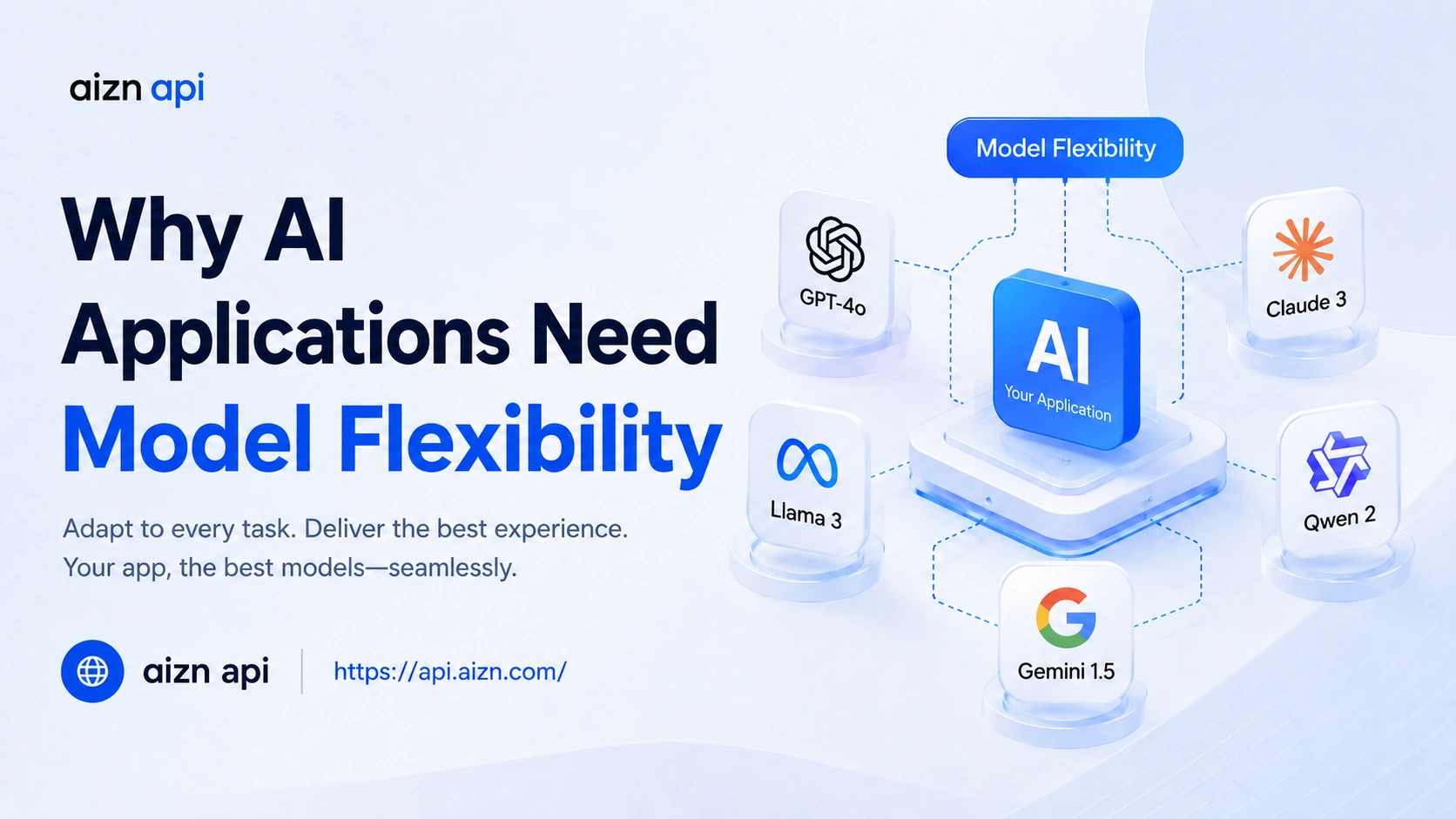
AI applications are becoming increasingly multi-model.
Modern AI products now rely on models from providers like:
- OpenAI
- Anthropic Claude
- Google Gemini
- DeepSeek
- Mistral
- Llama
Different models perform better for different workloads.
Some models are stronger at:
- reasoning
- coding
- long-context processing
- multimodal tasks
- cost-efficient inference
As a result, developers increasingly need access to multiple AI models simultaneously.
But integrating every provider independently creates major complexity.
This is why unified AI gateways are becoming critical infrastructure for modern AI development.
Why Multi-Model AI Is Becoming the Standard
No single AI model is ideal for every use case.
For example:
| Model | Common Strength |
|---|---|
| GPT models | General intelligence |
| Claude models | Long-context understanding |
| Gemini models | Multimodal workflows |
| DeepSeek models | Cost-efficient inference |
| Open-source LLMs | Flexible deployment |
Modern AI products increasingly require:
model flexibility.
This is especially important for:
- AI SaaS platforms
- AI Agents
- workflow automation
- AI copilots
- enterprise AI systems
Multi-model infrastructure is becoming the new standard.
The Problem With Separate AI APIs
Integrating every provider independently creates several challenges.
❌ Multiple SDKs
Each provider uses different:
- SDKs
- request structures
- authentication methods
- API standards
This increases engineering overhead significantly.
❌ Complex Infrastructure
Applications often require additional:
- routing systems
- failover logic
- provider orchestration
- request balancing
Managing this manually becomes difficult at scale.
❌ Difficult Model Switching
Switching providers often requires:
- backend modifications
- SDK rewrites
- infrastructure updates
- workflow adjustments
This slows experimentation.
❌ Fragmented Billing
Developers must manage:
- multiple invoices
- token tracking
- provider dashboards
- pricing systems
separately.
This creates operational inefficiency.
The Solution: Unified LLM APIs
Unified AI gateways solve these problems by providing:
one API for multiple AI models.
Instead of integrating providers individually:
Applications connect once and access multiple models through a centralized infrastructure layer.
This dramatically simplifies AI application development.
What Is a Unified LLM API?
A Unified LLM API is an AI gateway platform that provides standardized access to multiple AI providers through one API integration.
Instead of separately integrating:
- OpenAI API
- Claude API
- Gemini API
- DeepSeek API
developers use:
one unified endpoint.
The platform handles:
- routing
- provider abstraction
- authentication
- request normalization
- billing management
- infrastructure orchestration
This creates a much more scalable AI architecture.
Benefits of Using One API for Multiple AI Models
1. Faster AI Development
Developers integrate once instead of managing multiple APIs separately.
This significantly reduces development time.
2. Easier Model Switching
Applications can switch between providers without rebuilding backend systems.
This improves flexibility dramatically.
3. Simplified Infrastructure
Unified AI gateways abstract:
- provider differences
- request formatting
- authentication logic
- orchestration systems
This reduces engineering complexity.
4. Centralized Usage Management
Unified systems simplify:
- token tracking
- billing
- analytics
- usage monitoring
across multiple providers.
5. Better Scalability
Unified AI infrastructure scales more efficiently for:
- enterprise AI systems
- AI SaaS platforms
- AI Agents
- workflow automation
- customer support systems
What Is an AI Gateway?
An AI Gateway is a centralized infrastructure layer that manages communication between applications and multiple AI models.
AI gateways often include:
✔ multi-model routing
✔ API normalization
✔ token management
✔ provider abstraction
✔ failover systems
✔ usage analytics
✔ scalable orchestration
Modern AI infrastructure increasingly depends on AI gateways.
Why AI Developers Need Multi-Model Flexibility
AI systems evolve rapidly.
New models appear constantly.
Developers increasingly need the ability to:
- compare models
- switch providers
- optimize costs
- improve performance
- experiment rapidly
Unified AI APIs make this much easier.
Common Use Cases for Unified AI APIs
Unified AI infrastructure is increasingly used for:
AI chatbots
AI copilots
AI Agents
workflow automation
AI SaaS platforms
content generation
customer support AI
coding assistants
The more complex the AI system becomes, the more valuable unified infrastructure becomes.
How API AIZN Simplifies Multi-Model AI Access
API AIZN Official Website provides a Unified LLM API Gateway that helps developers access multiple AI models through one scalable API infrastructure.
API AIZN supports:
- multi-model AI access
- centralized API infrastructure
- scalable token-based usage
- simplified AI integration workflows
- unified AI application development
API AIZN Capabilities
✔ Unified LLM API
✔ OpenAI-compatible workflows
✔ Multi-model AI access
✔ AI Gateway infrastructure
✔ Centralized token management
✔ Scalable AI systems
✔ Simplified AI orchestration
This allows developers to build AI applications faster and more efficiently.
Why Unified AI Infrastructure Matters
AI development is shifting rapidly.
The industry is evolving from:
single-model applications
to:
multi-model AI ecosystems.
Future AI products increasingly depend on:
- AI gateways
- model orchestration
- unified APIs
- scalable inference systems
- provider flexibility
Businesses that adopt unified AI infrastructure early will gain major long-term advantages.
FAQ
Why use multiple AI models?
Different AI models perform better for different workloads such as reasoning, coding, multimodal processing, or cost optimization.
What is a Unified LLM API?
A Unified LLM API provides access to multiple AI providers through one API integration.
What is an AI Gateway?
An AI Gateway manages communication between applications and multiple AI providers through centralized infrastructure.
Why are unified AI APIs important?
Because they simplify infrastructure, reduce development complexity, and improve scalability.
What is API AIZN?
API AIZN is a Unified AI Gateway platform that provides access to multiple AI models through one API.
Conclusion
Modern AI applications increasingly depend on:
- multiple AI models
- scalable infrastructure
- flexible orchestration systems
- unified APIs
Managing separate AI providers manually creates major operational complexity.
Unified AI gateways simplify development and make multi-model AI applications dramatically easier to scale.
The future of AI development increasingly belongs to:
unified, scalable, multi-model AI infrastructure.