Most business websites were designed for the old internet.
Their purpose was simple:
- display company information
- show products
- collect inquiries
- support traditional SEO
For years, this model worked.
A website acted like a digital brochure.
Businesses mainly focused on:
- design
- homepage banners
- product catalogs
- search rankings
But AI-generated search is changing how online discovery works.
Today, users increasingly ask AI systems directly:
- “Best supplier?”
- “Recommended manufacturer?”
- “Which platform should I use?”
- “What solution fits this workflow?”
Platforms like:
- ChatGPT
- Gemini
- Perplexity
- Claude
increasingly generate answers instead of showing only website links.
That changes what websites need to do.
The future is no longer about simply having a website.
It is about having:
an AI-ready website.
Traditional Websites Were Built for Human Browsing
Most websites still assume users will:
- search keywords
- open pages
- browse manually
- compare information themselves
That behavior still exists.
But AI-generated search increasingly reduces manual browsing.
Users now expect:
- direct answers
- summarized recommendations
- contextual explanations
- workflow guidance
This changes how websites need to communicate information.
AI Systems Read Websites Differently
Humans care about:
- visual design
- branding
- animations
- layouts
AI systems care more about:
- semantic structure
- contextual clarity
- reusable information
- topic relationships
- structured explanations
A visually impressive website may still perform poorly in AI-generated search if the content structure is weak.
What Is an AI-Ready Website?
An AI-ready website is designed to help AI systems:
- understand business expertise
- identify semantic relationships
- extract structured knowledge
- connect workflows and use cases
- recommend the business confidently
An AI-ready website behaves less like a brochure…
and more like:
a continuously evolving knowledge system.
Why Static Websites Are Losing Visibility
Many traditional business websites remain mostly static after launch.
The company uploads:
- product pages
- certifications
- company profiles
- contact information
Then the website changes very little for months or years.
AI-generated search increasingly rewards websites that continuously expand:
✔ contextual information
✔ semantic coverage
✔ FAQ systems
✔ industry knowledge
✔ workflow explanations
Static websites gradually lose semantic relevance.
AI-Ready Websites Prioritize Semantic Structure
AI systems need clear information architecture.
Strong AI-ready websites usually include:
- structured H1 / H2 systems
- FAQ ecosystems
- educational content
- semantic topic clusters
- workflow explanations
- comparison pages
- contextual product content
This improves AI readability significantly.
Why Product Pages Alone Are No Longer Enough
Many business websites still rely heavily on product catalogs.
But AI systems increasingly need more context before recommending products or suppliers.
For example, AI systems also evaluate:
- use cases
- industries
- operational workflows
- buyer scenarios
- semantic authority
That is why AI-ready websites expand beyond simple product pages.
AI-Ready Websites Continuously Build Authority
Traditional websites are often treated as completed projects.
AI-ready websites operate differently.
They continuously expand through:
- semantic SEO
- GEO systems
- FAQ growth
- multilingual publishing
- contextual topic coverage
- AI-readable content operations
This creates stronger long-term visibility.
What Is GEO?
GEO stands for:
Generative Engine Optimization
GEO focuses on improving visibility inside AI-generated search systems.
Instead of only optimizing for rankings, GEO helps businesses improve:
- AI understanding
- semantic authority
- recommendation probability
- AI citations
- contextual visibility
AI-ready websites are one of the foundations of GEO.
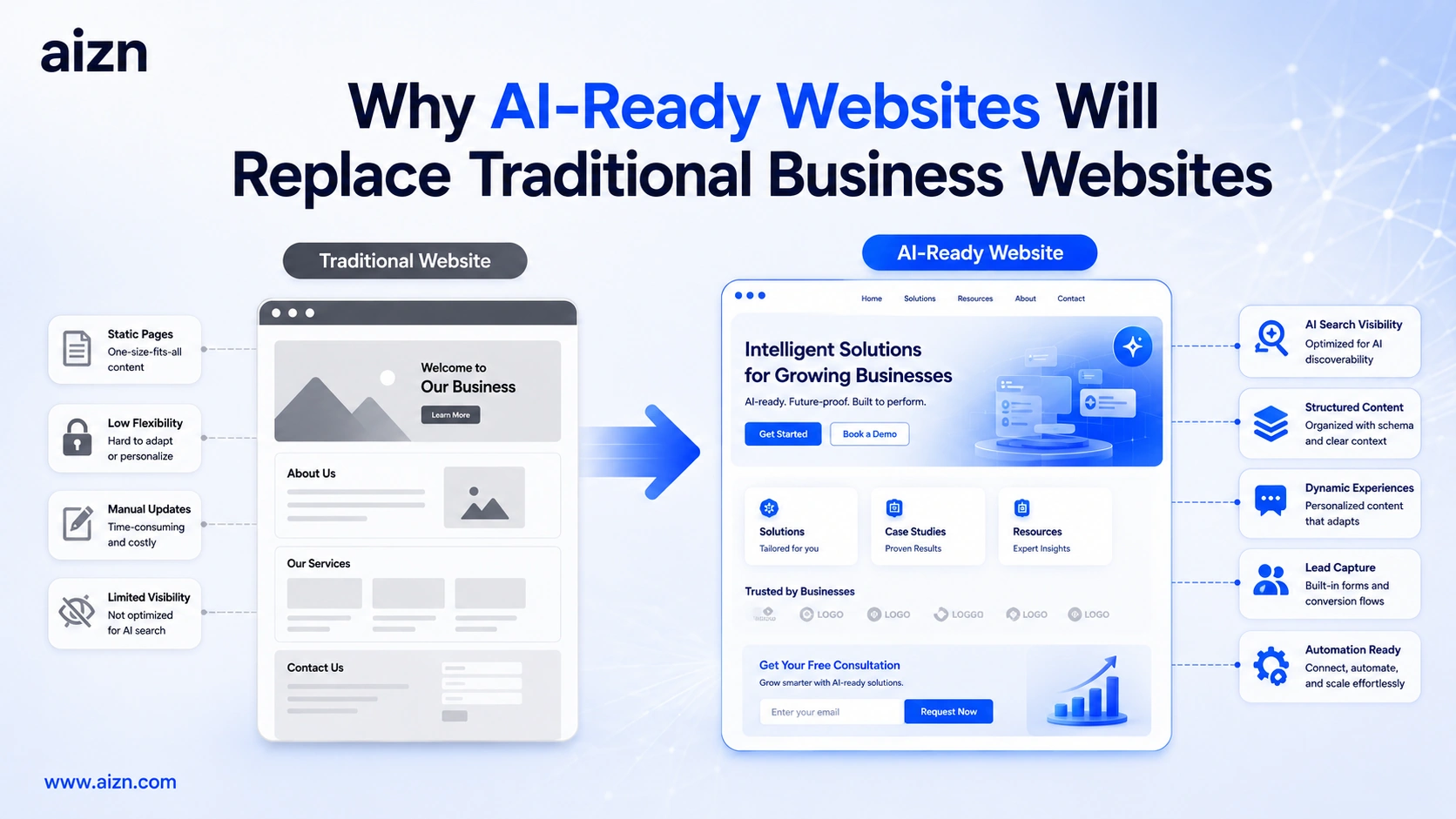
AI-Ready Websites vs Traditional Websites
| Traditional Website | AI-Ready Website |
|---|---|
| Static pages | Continuous semantic expansion |
| Design-focused | AI-understanding-focused |
| Product catalogs | Knowledge ecosystems |
| Search ranking focused | AI recommendation focused |
| Human browsing optimized | AI readability optimized |
The future increasingly belongs to semantic website systems.
Why FAQ Systems Matter More Than Ever
FAQ sections became surprisingly important in AI-generated search.
AI systems frequently reuse FAQ-style explanations because they are:
- structured
- direct
- semantically clear
- easy to summarize
Strong AI-ready websites usually contain layered FAQ ecosystems across:
- products
- industries
- workflows
- technologies
- operational topics
This improves AI visibility significantly.
Why Topic Ecosystems Matter
AI systems increasingly evaluate websites holistically.
They analyze how topics connect together.
A strong AI-ready ecosystem may include:
- GEO strategy
- semantic SEO
- AI-ready product pages
- FAQ optimization
- multilingual visibility
- AI search workflows
- industry use cases
These relationships strengthen semantic authority.
Why Multilingual AI Visibility Matters
AI-generated search is global.
Businesses increasingly need visibility across:
- multiple languages
- multiple regions
- multiple AI systems
AI-ready websites increasingly require:
✔ multilingual SEO
✔ semantic localization
✔ Hreflang systems
✔ multilingual FAQs
✔ localized contextual content
This becomes especially important for exporters and global B2B businesses.
Why AI-Ready Websites Matter for B2B Companies
This shift affects:
- manufacturers
- exporters
- SaaS companies
- suppliers
- industrial businesses
- AI platforms
because AI-generated search increasingly influences:
- supplier discovery
- product research
- solution evaluation
- workflow analysis
- purchasing decisions
Businesses that remain difficult for AI systems to understand may gradually lose visibility over time.
How AIZN Helps Businesses Build AI-Ready Websites
AIZN helps businesses build AI-ready websites designed for GEO, semantic SEO, and AI-generated visibility.
With AIZN, companies can create:
- semantic content ecosystems
- AI-readable product pages
- multilingual GEO systems
- structured FAQ architectures
- scalable content operations
- AI-ready website infrastructures
The goal is not simply to launch websites.
The goal is to build:
long-term AI visibility systems.
AIZN AI-Ready Website Capabilities
✔ GEO website systems
✔ Semantic SEO structures
✔ AI-readable website architecture
✔ Multilingual publishing
✔ FAQ ecosystem generation
✔ AI-ready product page systems
✔ Continuous content automation
This helps businesses improve long-term AI visibility.
FAQ
What is an AI-ready website?
An AI-ready website is designed to help AI systems understand, summarize, and recommend business information more effectively.
Why are traditional websites becoming less effective?
Because AI-generated search increasingly prioritizes semantic structure and contextual understanding instead of static presentation pages.
What is GEO?
GEO stands for Generative Engine Optimization, which focuses on AI-generated search visibility.
Why do AI-ready websites matter for B2B businesses?
Because AI systems increasingly influence supplier discovery, product research, and purchasing workflows.
What is AIZN?
AIZN is an AI platform that helps businesses build GEO-ready, semantic SEO, and AI-ready website systems.
Conclusion
Traditional business websites were built for an internet centered around manual browsing.
The AI search era requires something different.
Businesses increasingly need websites that continuously explain:
- expertise
- workflows
- industries
- products
- use cases
- semantic relationships
because AI-generated search increasingly depends on contextual understanding.
The companies that gain long-term visibility will not simply have better-looking websites.
They will have websites that AI systems can understand, trust, and recommend.
The future of websites is no longer static.
It is semantic, operational, and AI-ready.
Build AI-ready website systems with AIZN