A lot of companies are publishing more content than ever before.
Every week, businesses push out:
- SEO articles
- AI-generated blogs
- landing pages
- product pages
- keyword content
- marketing copy
On the surface, this looks productive.
Traffic dashboards move.
Page counts increase.
Publishing frequency improves.
But after looking closely at many websites, one pattern becomes obvious:
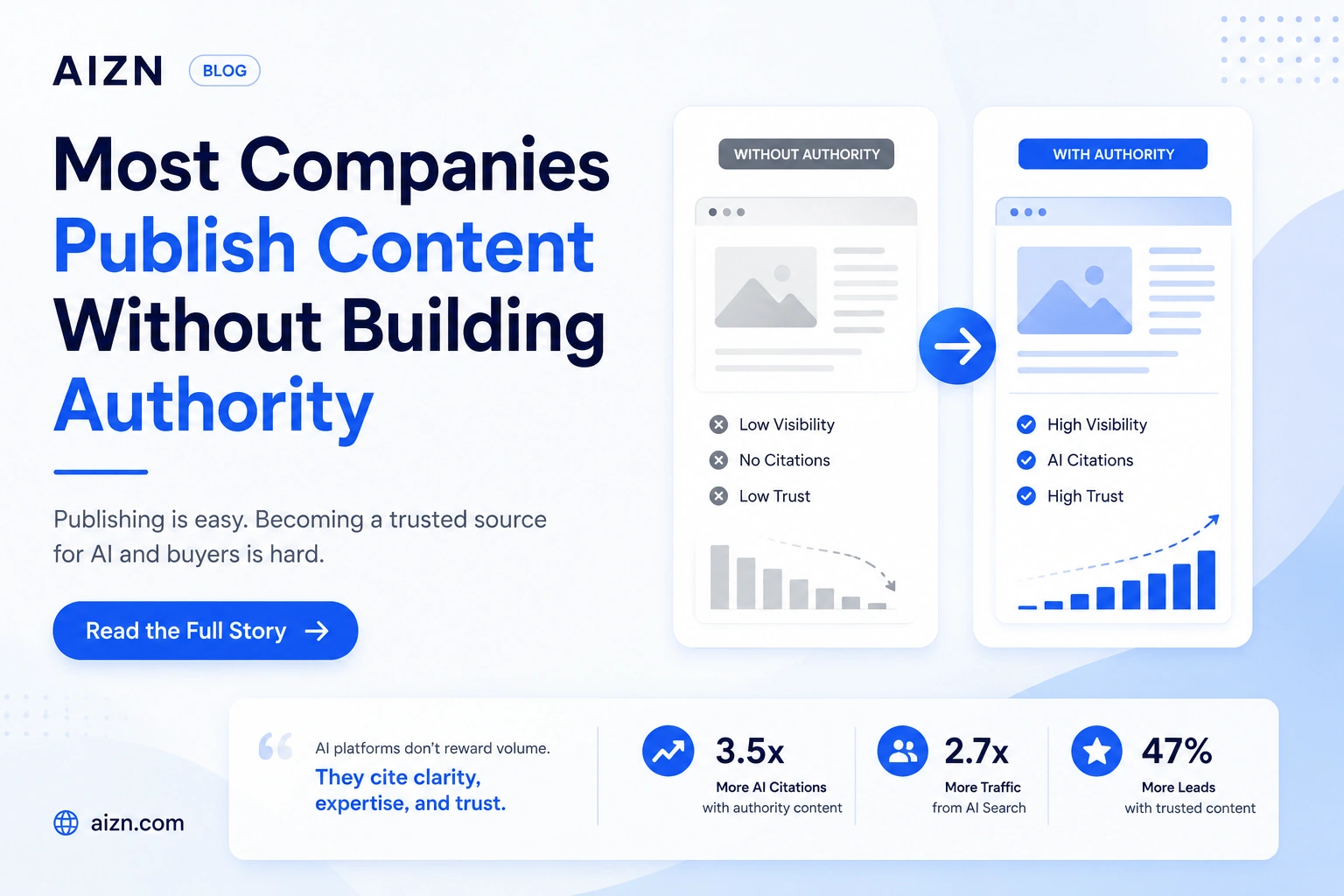
A large amount of content does not automatically create authority.
In many cases, companies are producing content continuously…
while building almost no real semantic trust.
Publishing Volume Became Easier Than Building Expertise
AI tools dramatically reduced the difficulty of content production.
Today, almost any business can generate:
- 100 blog posts
- product descriptions
- multilingual pages
- SEO articles
- marketing copy
within a very short time.
The internet is becoming saturated with content.
But AI-generated search systems are evolving in the opposite direction.
They increasingly prioritize:
- contextual understanding
- semantic consistency
- topical depth
- structured expertise
- trustworthy knowledge ecosystems
That means:
volume alone matters less than it used to.
Many Websites Look Large but Feel Empty
Some websites now contain:
- thousands of pages
- hundreds of keywords
- large publishing archives
But when AI systems analyze them, the content often lacks:
✔ depth
✔ contextual relationships
✔ expertise signals
✔ semantic consistency
✔ educational structure
The result is strange:
The website grows larger…
while its actual authority barely improves.
We Started Noticing the Same Pattern Repeatedly
A website may publish:
- “Best AI SEO Tool”
- “Top SEO Platform”
- “Best GEO Solution”
- “AI Search Optimization Guide”
But the content often repeats the same surface-level explanations.
Different titles.
Similar meaning.
Very little new knowledge.
AI systems are getting better at detecting this.
They increasingly evaluate:
whether a website genuinely understands a topic.
Not whether it simply produces more pages.
Authority Is Becoming Semantic, Not Mechanical
Traditional SEO often rewarded:
- keyword targeting
- backlinks
- publishing frequency
- page volume
Those factors still matter.
But AI-generated search increasingly evaluates something more difficult:
semantic authority.
This means AI systems try to determine:
- how deeply a website understands a topic
- whether concepts connect logically
- whether expertise appears consistent
- whether the information feels reusable and trustworthy
This creates a much higher content standard.
Semantic Authority Is Built Through Relationships
Strong authority usually comes from:
- connected ideas
- contextual explanations
- workflow understanding
- industry specificity
- educational depth
Not isolated articles.
For example:
A weak content strategy may publish:
- “Best GEO Tool”
- “AI SEO Platform”
- “Top SEO Software”
A stronger semantic ecosystem may explain:
- why AI search changes discovery
- how semantic SEO works
- how product pages fail in AI search
- how FAQ structures improve visibility
- how exporters use GEO
- how AI systems evaluate websites
This creates meaningful contextual relationships.
AI Search Rewards Understanding, Not Noise
Many businesses still think content strategy means:
publish more pages.
But AI-generated search increasingly rewards:
✔ clarity
✔ structure
✔ expertise
✔ contextual consistency
✔ semantic coverage
Large amounts of repetitive content may eventually weaken trust instead of improving it.
The Biggest Difference Between Content and Authority
Content is easy to produce.
Authority is difficult to build.
Authority requires:
- consistency
- depth
- topical structure
- contextual relationships
- long-term semantic expansion
This is why some smaller websites outperform larger ones in AI-generated visibility.
They may publish less…
but explain topics more clearly and more consistently.
Product Pages Alone Rarely Build Authority
Many B2B businesses still rely heavily on:
- product catalogs
- specifications
- company introductions
These pages are useful.
But AI systems increasingly need more context before recommending businesses confidently.
For example:
A supplier website becomes much stronger when it also explains:
- industry workflows
- manufacturing logic
- buyer considerations
- application scenarios
- operational problems
- comparison frameworks
This creates semantic depth.
FAQ Systems Became More Valuable Than Expected
One of the most underrated authority systems is the FAQ structure.
AI systems frequently reuse FAQ-style content because it is:
- concise
- direct
- contextual
- semantically clear
Strong FAQ ecosystems help websites become easier for AI systems to:
- interpret
- summarize
- reuse
- recommend
This is one reason structured content increasingly matters more than content volume.
Content Without Structure Creates Weak Signals
Many websites still publish articles randomly.
No relationships.
No topic architecture.
No semantic hierarchy.
This creates weak authority signals.
Strong semantic ecosystems usually organize content around:
✔ industries
✔ workflows
✔ concepts
✔ use cases
✔ comparisons
✔ buyer intent
This creates much stronger contextual understanding.
AI Search Is Changing What “Good Content” Means
Traditional SEO content often focused on:
- rankings
- keywords
- traffic
AI-generated search increasingly focuses on:
- usefulness
- trust
- semantic clarity
- contextual understanding
- structured knowledge
This changes content strategy completely.
The future is less about:
producing pages.
And more about:
building trusted semantic systems.
GEO Depends on Authority More Than Ever
GEO — Generative Engine Optimization — increasingly depends on:
- semantic consistency
- contextual trust
- educational structure
- reusable explanations
- topic ecosystems
AI systems need confidence before recommending information.
That confidence comes from authority.
Not volume alone.
Why This Matters for AI Visibility
Businesses increasingly compete for:
- AI recommendations
- semantic trust
- AI citations
- contextual discoverability
This means weak content strategies may create:
- more pages
- more keywords
- more publishing activity
while still generating very little real AI visibility.
How AIZN Helps Businesses Build Semantic Authority
AIZN helps businesses move beyond high-volume publishing by building:
- semantic content ecosystems
- GEO-ready topic structures
- AI-readable FAQ systems
- contextual content relationships
- multilingual authority systems
- scalable AI-ready publishing workflows
The goal is not simply to publish more.
The goal is to build:
trusted semantic visibility.
Conclusion
The internet already contains enormous amounts of content.
AI-generated search is making authority more important than volume.
Businesses that continue publishing disconnected, repetitive content may struggle to build long-term visibility.
The companies that win in AI search will increasingly be the ones that:
- explain topics clearly
- build contextual relationships
- create structured knowledge systems
- expand semantic authority continuously
because AI systems increasingly reward understanding — not just output.
Publishing content is easy.
Building authority is much harder.