Websites are entering a completely new era.
For years, businesses built websites mainly for:
- search engines
- product displays
- lead generation
- company branding
- online visibility
Traditional websites focused heavily on:
design + SEO + traffic.
But AI-generated search is changing how users discover businesses online.
Today, users increasingly ask AI systems directly:
- “Best manufacturer for CNC machines?”
- “Recommended AI website builder?”
- “Top SEO platform?”
- “Best supplier for exporters?”
Platforms like:
- ChatGPT
- Gemini
- Perplexity
- Claude
- DeepSeek
now generate answers instantly.
This changes how websites compete online.
Modern businesses no longer need only:
SEO-ready websites.
They increasingly need:
AI-ready websites.
What Is an AI-Ready Website?
An AI-ready website is a website optimized for both:
traditional search engines
and
AI-generated search systems.
AI-ready websites help AI systems:
- understand content
- trust information
- recommend businesses
- cite sources
- generate answers using website content
Unlike traditional websites, AI-ready websites focus heavily on:
- semantic structures
- AI readability
- GEO optimization
- AI visibility
- multilingual AI discovery
Why Traditional Websites Are No Longer Enough
Traditional websites were designed mainly for:
- human browsing
- keyword rankings
- manual navigation
- static content
But AI-generated search changes how information is discovered.
Users increasingly receive:
direct AI-generated recommendations
instead of manually browsing websites.
This means businesses now compete for:
- AI visibility
- semantic authority
- recommendation probability
- AI-generated citations
Traditional websites often fail to optimize for these new systems.
How AI Search Changes Website Visibility
Traditional discovery looked like this:
Search → Click → Website
AI-generated search increasingly looks like this:
Question → AI Answer → Recommended Brand
This changes the role of websites dramatically.
Websites are no longer only destinations.
They are increasingly:
knowledge sources for AI systems.
This is why AI-ready structures are becoming critical.
What Makes a Website AI-Ready?
Modern AI-ready websites typically include:
✔ semantic structures
✔ AI-friendly formatting
✔ FAQ systems
✔ GEO optimization
✔ multilingual publishing
✔ structured informational content
✔ AI-readable layouts
AI systems prefer websites that are easy to process and summarize.
Why GEO Matters for Websites
GEO stands for:
Generative Engine Optimization
GEO focuses on optimizing websites for AI-generated search systems.
The goal is to increase the probability that AI systems will:
- understand your business
- trust your content
- cite your pages
- recommend your brand
GEO is becoming one of the most important parts of modern website strategy.
What Type of Website Content Performs Best?
AI systems strongly prefer:
- definitions
- FAQs
- comparison pages
- industry guides
- tutorials
- semantic explanations
- structured informational blocks
Examples include:
- What Is GEO?
- Best AI Website Builder
- AI SEO Strategies
- How AI Search Works
- GEO vs SEO
These formats align naturally with AI-generated answers.
Why Semantic Structures Matter
AI systems analyze:
- contextual meaning
- topical relationships
- semantic consistency
- authority signals
- structured information
This means websites should focus more on:
semantic organization
instead of keyword repetition alone.
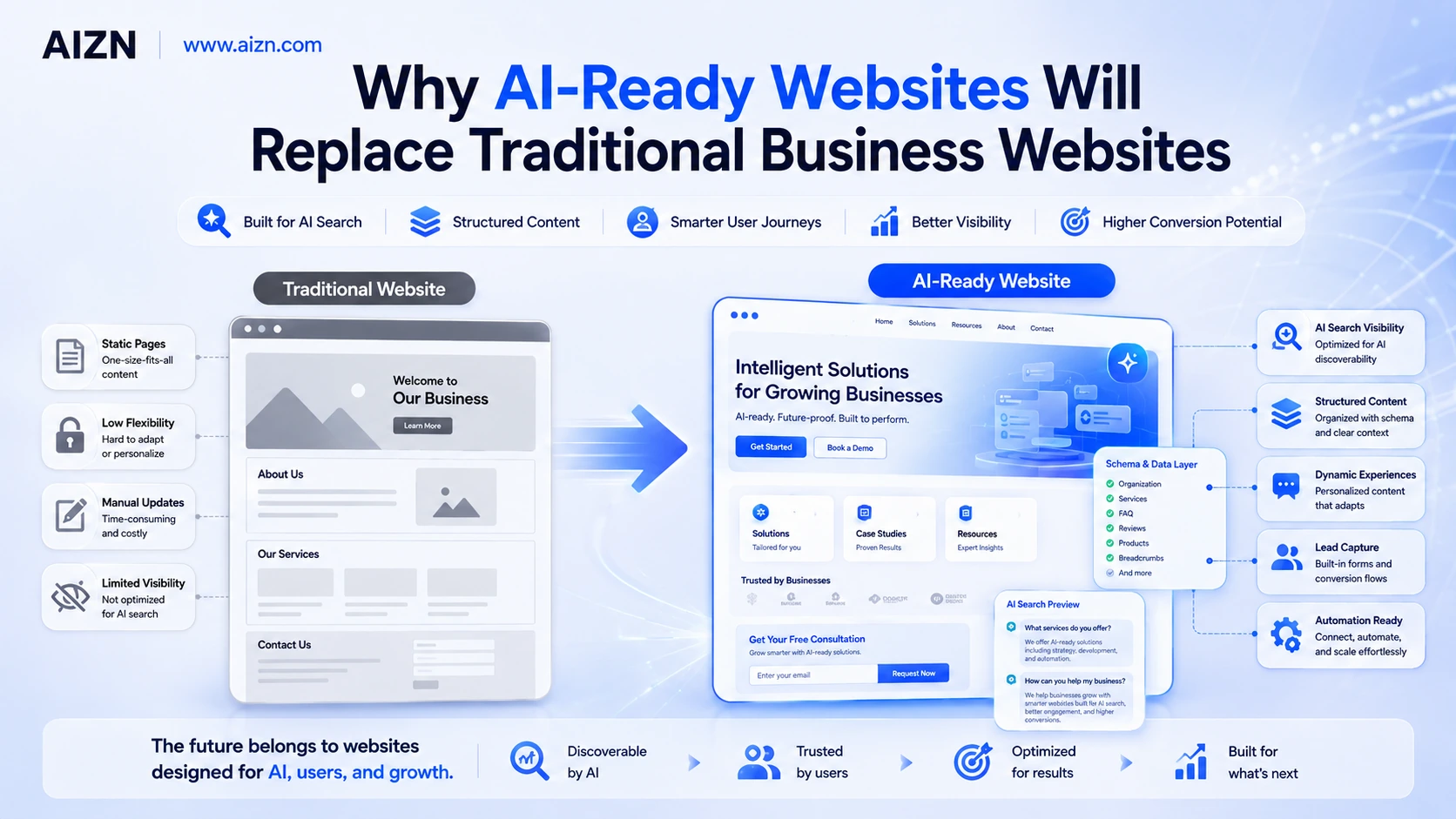
AI-Ready Websites vs Traditional Websites
| Traditional Website | AI-Ready Website |
|---|---|
| Keyword-focused | Semantic-focused |
| Human browsing optimized | AI-readable optimized |
| SEO-only strategy | SEO + GEO strategy |
| Static structures | AI-friendly structures |
| Manual content systems | Automated AI content systems |
| Limited AI visibility | AI-generated visibility |
The future increasingly belongs to AI-ready infrastructure.
Why Multilingual AI Visibility Matters
AI-generated search is global.
Businesses increasingly need visibility across:
- multiple languages
- multiple markets
- multiple AI systems
AI-ready websites increasingly require:
- multilingual structures
- Hreflang optimization
- localized semantic content
- multilingual GEO systems
This becomes especially important for exporters and international businesses.
Why Continuous Content Matters
AI systems favor:
- active websites
- expanding topic authority
- updated content
- growing semantic ecosystems
Businesses that continuously publish AI-friendly content improve long-term visibility significantly.
How AIZN Helps Businesses Build AI-Ready Websites
AIZN AI helps businesses build AI-ready websites optimized for both traditional SEO and AI-generated search visibility.
AIZN combines:
GEO + SEO + Data + AI Agents
to help businesses improve:
- AI visibility
- semantic authority
- multilingual publishing
- AI-friendly website structures
- AI-generated content systems
AIZN AI Website Capabilities
✔ AI-generated websites
✔ automated SEO systems
✔ multilingual AI publishing
✔ GEO-ready structures
✔ AI-friendly formatting
✔ AI citation optimization
✔ semantic SEO systems
This helps businesses prepare for the future of AI-driven visibility.
Why Early Adoption Matters
AI-generated search is still evolving rapidly.
Businesses that adopt AI-ready websites early can:
- establish semantic authority faster
- improve AI recommendation visibility
- strengthen AI trust signals
- gain long-term competitive advantages
Over time, AI systems will increasingly favor trusted semantic authorities.
The Future of Websites
Websites are entering the AI era.
The industry is shifting from:
traffic-focused websites
to:
AI-search-ready digital infrastructure.
Future websites increasingly depend on:
- GEO
- AI Search Optimization
- semantic authority
- AI-generated visibility
- multilingual AI discovery
Businesses that adapt early will dominate future AI-driven discovery systems.
FAQ
What is an AI-ready website?
An AI-ready website is optimized for both traditional search engines and AI-generated search systems.
Why are AI-ready websites important?
Because AI-generated search increasingly influences how users discover businesses online.
What is GEO for websites?
GEO stands for Generative Engine Optimization, which focuses on optimizing websites for AI-generated visibility.
What type of content performs best for AI search?
Definitions, FAQs, tutorials, comparison pages, and structured informational content.
Why is semantic structure important?
Because AI systems analyze contextual relationships and semantic organization, not just keywords.
Conclusion
Websites are no longer built only for human visitors.
They are increasingly built for:
- AI systems
- recommendation engines
- semantic understanding
- AI-generated search visibility
Traditional SEO remains important.
But future digital visibility increasingly depends on:
AI-ready website infrastructure.
Businesses that adapt early will gain a major long-term advantage in the AI search era.